OptiNod
MACD Pressure Rotation 1H
A BTC 1H strategy that routes MACD histogram pressure through five playbooks for trend, overheat, reclaim, and rejection setups.
THE IDEA
Most MACD strategies reduce the indicator to a single switch: the MACD line crossing its signal, or the histogram changing sign, and that switch is traded the same way in every market. The symmetry is the weakness.
A histogram flip means one thing inside a clean trend, something else at the exhausted top of a long run, and something else again during a failed bounce inside a range.
This strategy keeps the MACD histogram at its core, but instead of treating it as an on/off signal it reads it as a continuous measure of momentum pressure — and then routes that pressure into separate playbooks chosen by the market context around it.
In other words, the question is never only "did momentum turn?" It is "momentum turned — where, and into what?"
The answer decides which playbook takes the trade, how large it is, and how it is managed.
READING THE HISTOGRAM AS PRESSURE
A standard MACD reading is binary: above or below zero, crossover or no crossover.
Here the histogram is measured on three dimensions at once, each normalized by ATR so that one set of thresholds behaves the same way across calm and violent volatility:
- Magnitude — how large the histogram is relative to ATR. A thrust is only acknowledged once its size clears an ATR-relative floor, which filters the small, noisy flips that produce most false MACD signals.
- Slope — the bar-over-bar change of the histogram, ATR-normalized. This measures how fast momentum is building, not merely whether it is positive or negative.
- Acceleration — the change of the slope. The strategy wants momentum that is both turning and curling in the trade direction, so it requires the second derivative to agree as well.
On top of these, entries look for a local inflection of the histogram — a fresh turn up from a local trough, or down from a local peak — rather than a lagging signal-line crossover.
The aim is to catch momentum re-igniting after a pause inside an existing move: a new push, not a crossover that has already spent itself.
ATR-normalization throughout is what lets the same gates apply consistently as BTC moves between quiet and explosive regimes on the 1-hour chart.
ASYMMETRIC ROUTING — THE CENTRAL MECHANISM
Once a qualifying thrust appears, the strategy asks where it is happening: inside a confirmed trend or in chop, early or already extended, near the middle of the recent range or stretched far from the moving averages, aligned with the longer-term (macro) trend or fighting it.
The same momentum reading is then handed to the playbook built for that situation. Five playbooks cover the realistic cases, and each one carries its own entry conditions, position size, and exit plan. No single rule is applied to every context.
MARKET-STATE FILTER
Before any momentum signal is considered, a state filter decides whether the market is tradable and in which direction:
- Fast and slow EMA alignment (defaults 34 and 144) plus the slow-EMA slope establish the trend direction and confirm it is actually moving rather than drifting flat.
- A range-width band and a volume floor screen out dead, illiquid, or blown-out conditions where edges decay.
- A 4-hour EMA bias must agree with the entry direction, so 1-hour entries are taken with the higher timeframe rather than against it.
The trend playbooks arm only inside a valid bull or bear state.
The recovery playbooks operate just outside that state, under tighter conditions, to recapture moves the strict trend filter would otherwise miss.
THE FIVE PLAYBOOKS
- Trend Long (LT) — the profitable core. In a confirmed up-state, it buys the recovery of a pullback toward the fast EMA on a fresh upward thrust, gated by RSI and by distance-from-EMA caps so it joins the trend without chasing.
- Overheat Long (LO) — a valid long that has already run a long way (steep macro slope, large trailing return, or a wide gap above the macro EMA) is not simply discarded. It is rerouted to a managed path with a tighter stop, nearer targets, and a shorter maximum hold. The signal is respected, but handled with more caution because late-trend entries fail differently than early ones.
- Long Reclaim (LR) — a shorter-hold recovery long, taken when price reclaims the fast EMA outside a fully confirmed up-state. It is gated by RSI bounds, EMA distance, and a small-histogram condition so it enters early into a turn rather than late into an extended push.
- Trend Short (ST) — in a confirmed down-state, shorts the failure of a retracement back toward the fast EMA on a downward thrust, with volatility and slope guards.
- Short Rejection (SR) — fades a push that fails to break the fast EMA and rolls back over, taken outside a confirmed down-state as a quick counter-move rather than a held position.
The short side is intentionally quicker and more selective than the long side. Sustained downside follow-through is rarer and harder to hold than upside continuation, so the short playbooks favor faster targets and shorter holds instead of trying to ride a trend the way the long core does.
RISK-GRADED SUB-CLASSIFIERS
Within the trend playbooks, a stack of sub-classifiers — fragile, stretched, volatile-pop, snapback, macro-stale, crowded — recognizes lower-quality contexts.
Rather than blocking those entries outright, it cuts their position size sharply. Marginal setups still participate, but small, so the strategy keeps sampling difficult conditions without betting full size on them.
This is a deliberate alternative to a hard yes/no filter, which throws away information and shrinks the sample.
ENTRY QUALITY GATES
Every entry must also clear hard caps on RSI and on distance from the EMAs measured in ATR, in addition to the pullback-proximity requirement.
These exist to prevent the classic MACD failure — buying strength that is already over-extended — and to keep fills close to structure where the stop can be meaningful.
RISK SIZING
Position size is not fixed. The distance from entry to the initial ATR-based stop is solved so that being stopped out costs a fixed fraction of equity (default 2%). The resulting quantity is then capped by a maximum notional leverage.
When volatility rises, the stop widens and the size shrinks automatically, so per-trade risk stays roughly constant instead of ballooning in fast markets.
EXIT MANAGEMENT
Each trade scales out in stages: a first take-profit (TP1) and a second (TP2), both expressed in R — multiples of the initial risk distance — followed by a runner.
After TP1 is reached, the stop is moved to breakeven; the remainder then rides an ATR trailing stop so winners can extend while the downside is removed.
The overheat and reclaim playbooks use tighter target, trail, and maximum-hold profiles than the trend core, matching their shorter expected life. A maximum-hold-time limit closes positions that stall without resolving.
TRADING HALT (PROTECTION)
A protection layer can stop new entries regardless of how good a signal looks.
It halts when equity drawdown from the peak exceeds a limit (default 40%), pauses after a loss streak (with separate per-side and overall counters), and enforces a cooldown after every exit to avoid immediately re-entering the same failing spot.
Open positions still exit through their normal stops and targets; only new entries are blocked while protection is active.
ON-CHART TOOLS
- A trend-strength gradient EMA ribbon and a market-state background tint.
- Per-playbook entry markers, plus stop, TP1, and TP2 level lines with price tags. A target line disappears automatically once price reaches it, so only the levels still in play remain on the chart.
- A top-right dashboard: market state, current position, active playbook, equity drawdown, net P/L, win rate, and trade count, with a Trading-Halted banner that appears only while entries are paused.
INPUTS AND DEFAULTS
Only the roughly 36 core knobs are exposed as inputs, and each one carries a tooltip explaining what it does. The many internal playbook thresholds are fixed to validated defaults to keep the interface manageable.
The strategy is built for the 1-hour timeframe and ships assuming 10,000 initial capital, 0.05% commission, and 1-tick slippage.
HOW TO USE
Start on the 1-hour chart with the defaults, then adjust to your instrument: trade direction (both sides, long-only, or short-only), the 4-hour-bias toggle, and the risk and exit values.
Raise the risk percentage and leverage cautiously — they scale exposure directly.
The protection limits (equity-drawdown halt, loss-streak pause, cooldown) are there to keep the strategy idle through its worst stretches, and are worth tuning to your own tolerance rather than turning off.
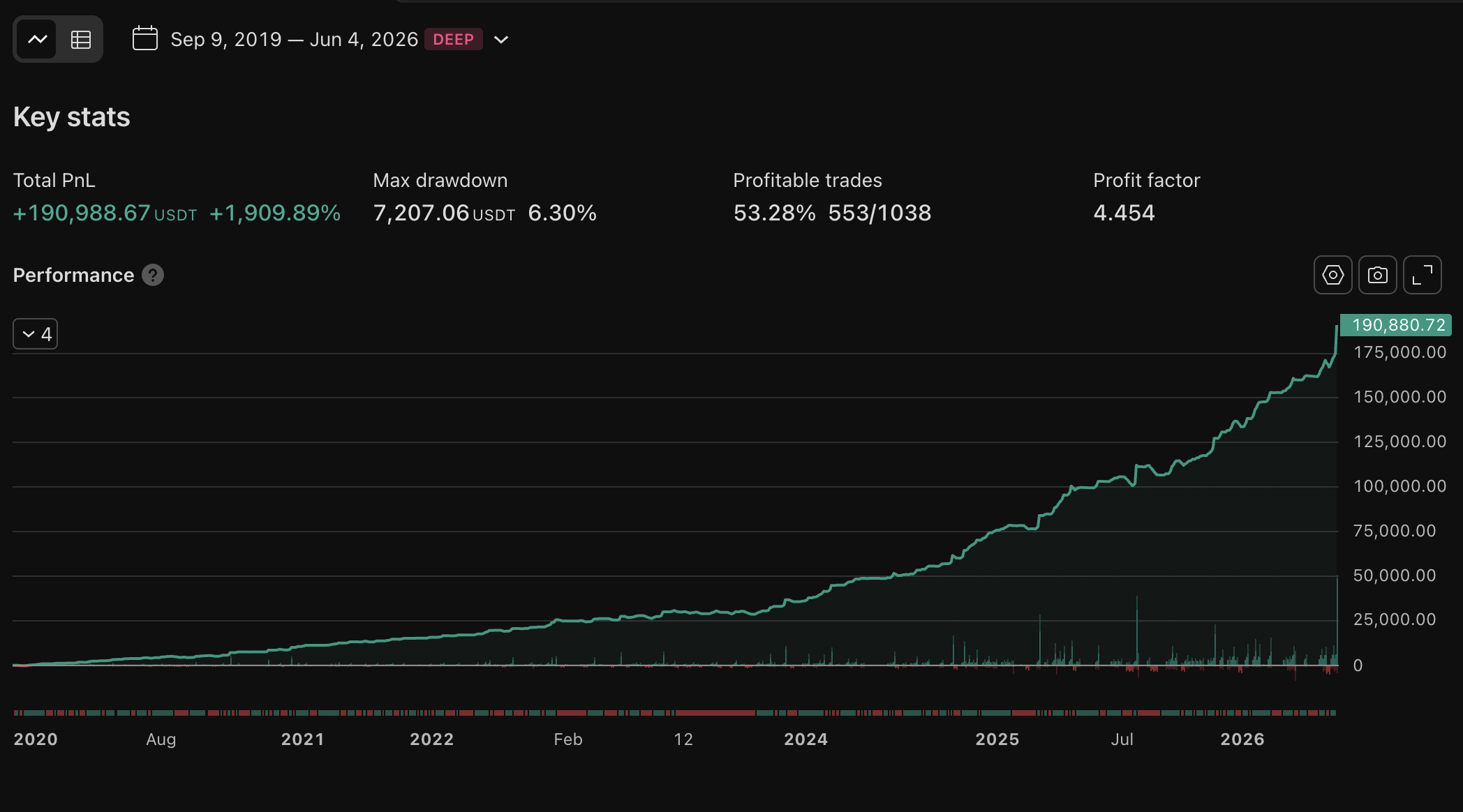
BACKTEST PERFORMANCE