OptiNod Academy
Harmonic Elliott Wave (Part 1) — The Single Modification That Turned the Impulse Into Three Waves
Where orthodox Elliott divides the impulse into five waves, Ian Copsey reads it as three (a-b-c). This covers HEW's single modification and the complete trend structure that results.
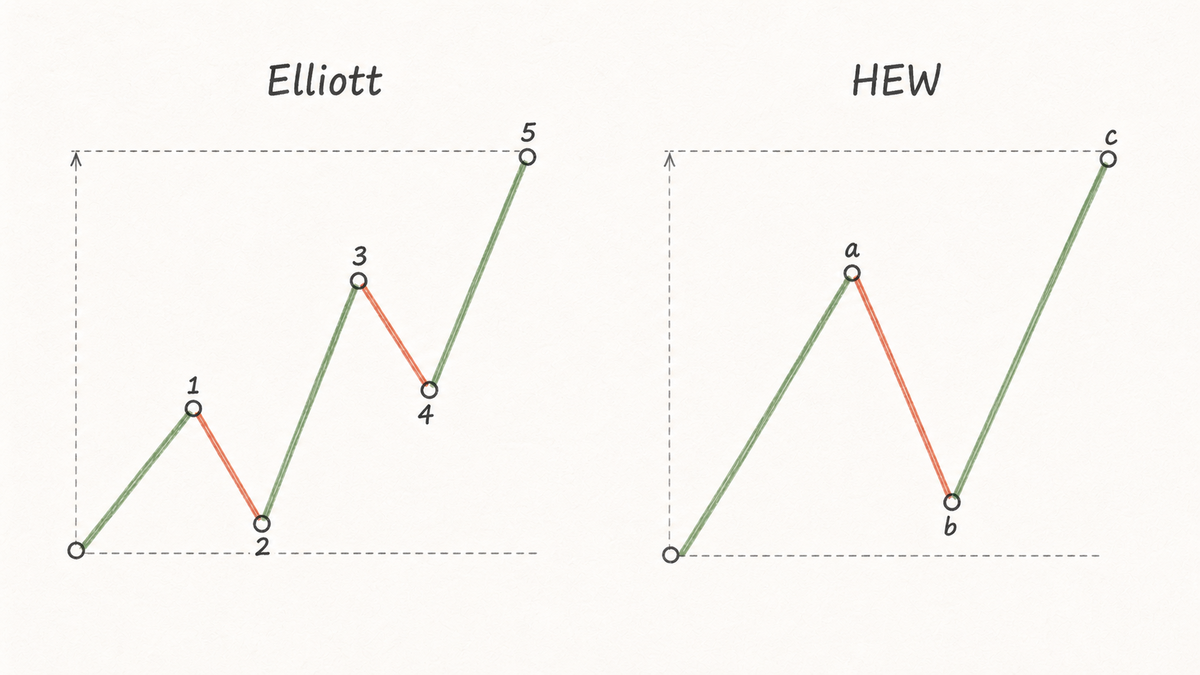
Harmonic Elliott Wave changes orthodox Elliott in a single respect: where orthodox Elliott divides the impulse waves 1, 3, and 5 into five waves, it reads each impulse as three waves (a-b-c).
Harmonic Elliott Wave (HEW) is a counting theory laid out by Ian Copsey in his 2011 book Harmonic Elliott Wave. From the name alone it sounds like some fusion of Elliott Wave and harmonic patterns. The actual content is not that. It is a modification that changes a single rule of orthodox Elliott Wave. Part 1 covers what that modification is and what the trend structure looks like once you make it. The ratio system comes in Part 2, and the structure of corrections in Part 3.
Three Things One Word Lumped Together
Because the single word "harmonic" is used for two schools of different origin, confusion arises.
Most traders know two things separately. One is the wave theory of Ralph Nelson Elliott — the account that markets trace five waves in the direction of the trend and three waves against it, with the same shape repeating across larger and smaller degrees. In orthodox Elliott, impulse waves 1, 3, and 5 each subdivide again into five smaller waves, while corrective waves 2 and 4 subdivide into three. The core work is counting waves and assigning degree. It is not a matter of fitting a fixed figure.
The other is harmonic patterns — the family proposed by H.M. Gartley in 1935 and organized by Larry Pesavento and Scott Carney with Fibonacci ratios layered on top. These are geometric patterns made of the five points X-A-B-C-D, and when each leg satisfies a prescribed Fibonacci retracement or extension ratio, a Potential Reversal Zone (PRZ) forms at the final D point. The trader looks to reverse there. The required ratios differ by pattern: D sits at 0.786 of XA for the Gartley, 0.886 for the Bat, 1.27 for the Butterfly, 1.618 for the Crab. There is no counting of waves or assigning of degree in this family. It looks only at the geometric structure of price and its ratios.
The name "Harmonic Elliott Wave" sounds like a fusion of these two. It is easy to guess it is a tool that lays a Gartley pattern over Elliott Wave. The more thoroughly someone knows both, the more confused they get. Since the word "harmonic" points to the Gartley family, they read it as a blend of Elliott counting with PRZ reversal trading. In reality HEW contains no five-point X-A-B-C-D figure, no PRZ, and no D-point trade. The "harmonic" in the name refers to the harmony of the ratios that join one wave to the next. Copsey says he learned of the ratio √2 — which appears often in musical intervals — from an acquaintance, and "harmonic" is borrowed from that musical harmony. The roots of HEW are in orthodox Elliott, because it is a modification that fixes a single rule of orthodox Elliott. It is far from the Gartley family and close to orthodox Elliott.
It is better to clear up the misunderstanding the name invites in advance. If your code or tooling has both a "harmonic pattern" module and an "Elliott harmonic" module, the two are different functions. The former is X-A-B-C-D figure matching and PRZ calculation; the latter is wave counting and ratio cross-checking. You should not mix the two modules or pull the logic of one into the other. All they share is the word and the use of Fibonacci numbers; structurally they do not overlap.
Copsey's Single Modification
Orthodox Elliott reads an impulse as five waves. Copsey reads it as three waves (a-b-c).
In orthodox Elliott an impulse divides into five sub-waves. Copsey is a technical analyst who spent more than 25 years analyzing exchange rates. After reviewing long-run data, he judged that dividing impulses into five this way frequently disagreed with actual price movement. The modification he put forward is a single one: impulse waves 1, 3, and 5 each unfold as three sub-waves, a-b-c.
Copsey says he got the clue from the "Special Wave A" that Prechter discussed in 1986. This is the case where a diagonal triangle structure takes the place of wave A of a correction, and here the impulse leg of wave A does not fill out all five but ends in three waves. In Copsey's own terms, it is a form in which waves (i), (iii), and (v) all unfold as three waves. He extended this exception into a general rule, taking the view that every trending impulse moves the same way.
This modification inverts the meaning of the labels. In orthodox Elliott, a five-wave package can be impulse wave 1, 3, or 5, or it can be A or C of a correction. In Copsey's system, a five-wave package can only be a wave a or a wave c. The trend-leading waves 1, 3, and 5 are three-wave packages. So when you see a clean five waves on the chart, it cannot be an impulse wave 1, 3, or 5. You have to read it as a wave a or c position inside a larger impulse.
This difference shows up immediately when you count waves. Stretches where the orthodox method forced a fit of five waves often fall into place cleanly on the three-wave skeleton. Copsey holds that whenever orthodox counting disagrees with reality, you have to drag in exceptions such as a "failed fifth" or an "extension." On the three-wave skeleton, a fair number of those exceptions become unnecessary. His grounds for putting forward this modification sit in the same place: counting in threes makes the ratios that join one wave to the next fit more consistently. That ratio system is covered in Part 2.
The Complete HEW Trend Structure
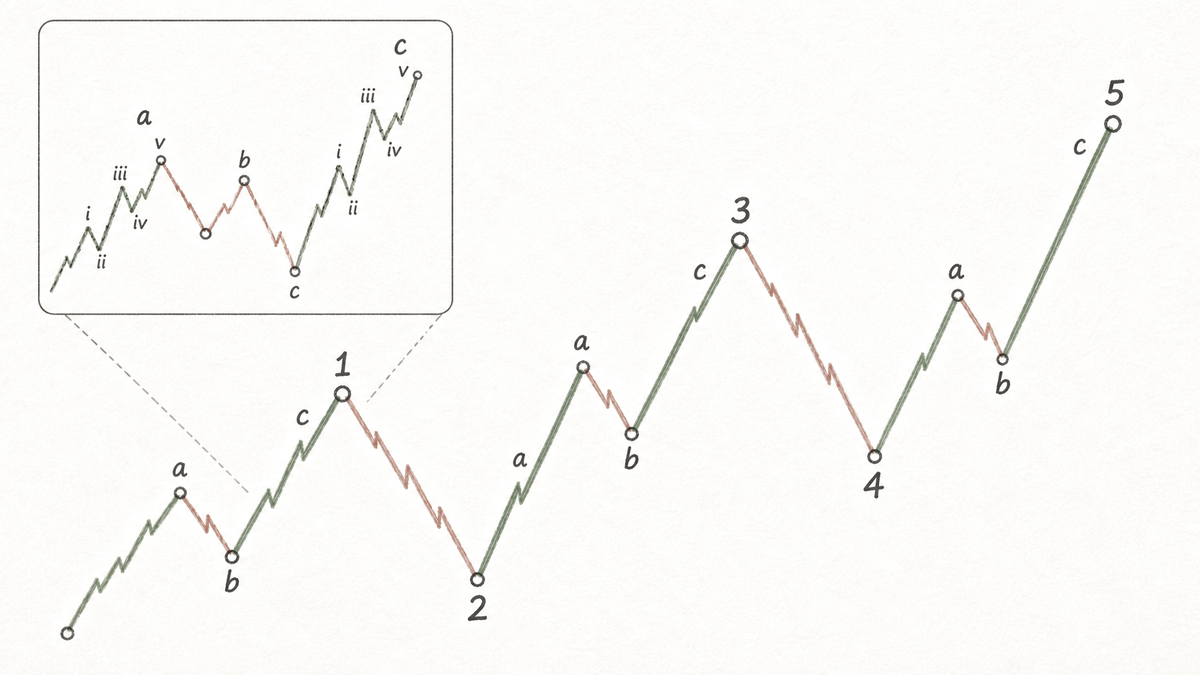
The top-level labels are 1-2-3-4-5, the same as orthodox. The inside of each impulse is the three waves a-b-c, and the a and c within it subdivide again into five waves.
A completed trend at one degree is 1-2-3-4-5. The top-level labels are the same as orthodox Elliott. The difference lies beneath them.
- Impulse waves 1, 3, and 5: each unfolds as the three waves (a)-(b)-(c). Where the orthodox 1, 3, and 5 were five waves, these are read as three.
- Wave a and wave c: the trend-direction legs, each subdividing again into five waves (i-ii-iii-iv-v). The five-wave skeleton appears only in these positions.
- Wave b: the retracement leg between a and c, subdividing into three waves.
- Corrective waves 2 and 4: the retracements between impulses, unfolding as three-wave forms.
In summary, a single impulse takes the form [a (five waves) · b (three waves) · c (five waves)]. The large trend-leading 1, 3, and 5 are always a three-wave skeleton. The five-wave structure appears only in the a and c positions inside them.
Here the real difference from orthodox can be stated in one line. Orthodox Elliott reads impulse wave 1 as a single level of five waves. HEW reads impulse wave 1 as two levels: a three-wave skeleton (a-b-c) at one level, and the five waves inside that a and c at another. Where orthodox compresses the stretch into one degree, HEW spreads it across two. It means reading the same price movement one step more finely.
This structural change also changes how you count. In orthodox terms, the trend-leading sub-legs number three: 1, 3, and 5. In HEW, since the a and c of each impulse lead the trend, they number six: a-of-1, c-of-1, a-of-3, c-of-3, a-of-5, c-of-5. The retracement legs also grow from the orthodox two (2 and 4) to five: b-of-1, 2, b-of-3, 4, b-of-5. As the unit of counting splits finer, you track a single trend cycle through denser nodes.
Where HEW Sits Within the Elliott Family
HEW is one of several branches that refine Elliott. It splits from NEoWave on how many waves the impulse divides into, and from the Gartley family on the very nature of the work.
HEW is not the only attempt to refine Elliott Wave more rigorously. Glenn Neely's NEoWave is a modification with the same aim. The two theories start from the same point but diverge on a key choice. NEoWave keeps the impulse as five waves. Instead it strictly prescribes the construction procedure for building waves up and the rules of time. HEW changes the impulse to three waves. The center of its discipline is the cross-checking of ratios. Where NEoWave treats time as a key variable, HEW fills the same place with ratio. On how many waves to divide an impulse into, the two theories arrive at opposite conclusions: NEoWave says five, HEW says three. Neely's NEoWave and Copsey's HEW belong to the same Elliott family, but they do not mesh.
The relationship with the Gartley family of harmonic patterns is simpler. The two families share only the word "harmonic." The Gartley, Bat, Butterfly, and Crab are five-point X-A-B-C-D geometric patterns, and they look to reverse at the D-point PRZ. They do not count waves and do not assign degree. HEW is a counting theory that counts waves and assigns degree. The very kind of work is different. In the Gartley family, Fibonacci is the rule that defines the pattern itself; in HEW, ratio is a verification tool that checks whether already-counted waves fit one another. Even using the same Fibonacci numbers, the way they are used is the reverse. This separation is taken up again in Part 2 when we cover the ratio system.
One thing from all this is enough to keep. HEW is a modification that fixes a single thing in orthodox Elliott, and that modification is reading the impulse as three waves. This one line becomes the foundation of the ratio system.
In the following [Part 2], we cover how HEW joins one wave to the next by ratio, and where the ratios unique to HEW — such as the 41.4% and 58.6% derived from √2 — are used.