OptiNod Academy
Harmonic Elliott Wave (Part 2) — The Ratio System and Cross-Confirmation
Where do HEW's ratios come from and what are they measured against? This covers the Fibonacci, √2, and additive ratios, and the cross-confirmation by which several degrees confirm one another at a single price zone.
In HEW, ratio is the standard that verifies the count. A count holds when the ratios of several degrees confirm one another at a single price zone.
[Part 1] covered the single modification of Harmonic Elliott Wave (HEW). Where orthodox Elliott divides impulse waves 1, 3, and 5 into five waves, Ian Copsey reads the impulse as three waves (a-b-c). Those a and c subdivide again into five waves, and b into three. Since that structure was explained fully in Part 1, Part 2 goes straight into the ratio system that operates on top of it.
In HEW, ratio is the verification tool that decides whether a count is correct. Its position differs from orthodox Elliott, which uses ratio as a supplementary reference. The orthodox method follows the order of first labeling waves as they appear and then laying Fibonacci retracements over them as a reference. HEW reverses the order. It first asks whether the ratios line up, and accepts only the counts that pass. Copsey's grounds for re-reading the impulse as three waves sit in the same place: the observation that when counted in fives the ratios frequently disagreed, and when counted in threes the ratios joining one wave to the next fit more consistently. The ratio system is the foundation of HEW. This article covers, in turn, where those ratios come from, what they are measured against, and how they verify a count.
Three Sources of the Ratios
Copsey's ratios come from three sources: the Fibonacci sequence, √2-derived values, and additive ratios.
Copsey draws ratios from three places. Rather than leaning on the familiar Fibonacci retracements alone, he ties three sources together to build a denser grid.
- The Fibonacci sequence: the base set of sub-100% ratios HEW uses is 5.6%, 9.0%, 14.6%, 23.6%, 33.3%, 38.2%, 50%, 61.8%, 66.6%, 76.4%, 85.4%, 90.0%, 95.4%. Alongside familiar values like 38.2, 61.8, and 76.4, the set also includes fine residual ratios such as 5.6, 9.0, and 14.6 that orthodox tools rarely use. The set above 100% continues with 161.8%, 261.8%, 423.6%, 685.4%, and so on. The residual ratios are included because when measuring short waves at a small degree, the grid is too sparse with the large ratios alone.
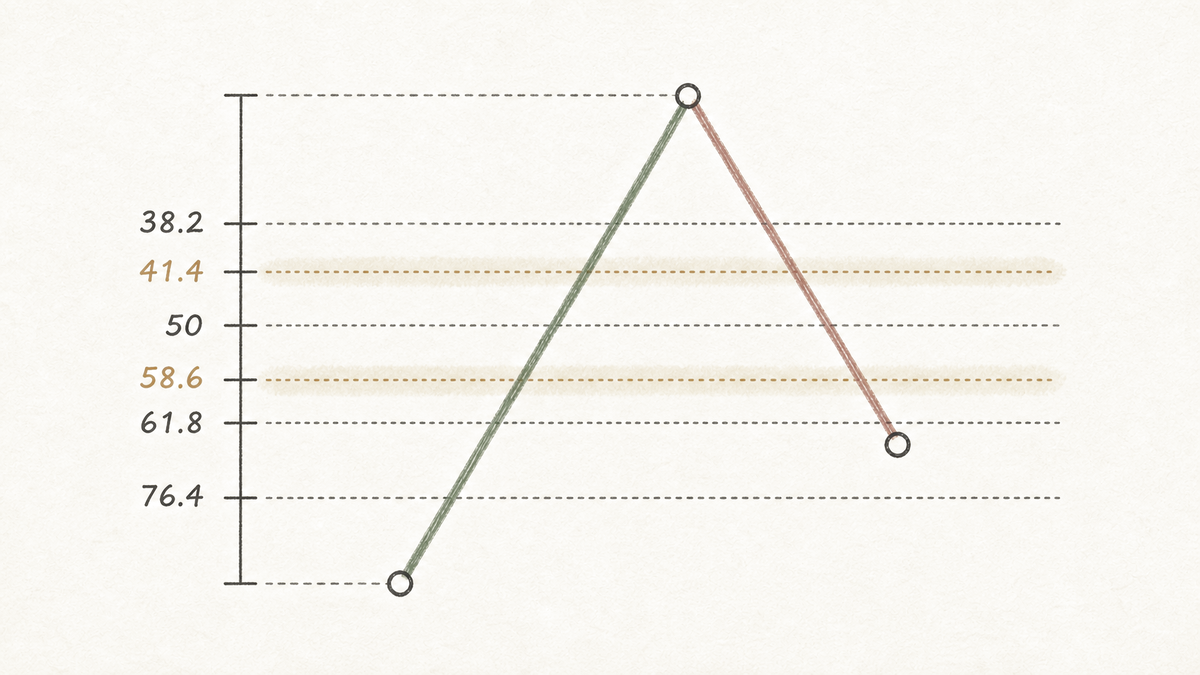
- √2 (1.41421…) derived values: the source that characterizes HEW. 41.4% comes from √2−1, and 58.6% is its complement, 100−41.4, equal to 2−√2. Copsey says he drew on this source after an acquaintance told him √2 appears often in musical intervals. 41.4% and 58.6% are values unique to HEW, almost absent from orthodox Elliott tools. These two values fill the gaps between 38.2 and 50, and between 50 and 61.8. When a retracement departs from 38.2, 50, or 61.8 and halts at 41.4 or 58.6, where an orthodox tool would read a deviant value, HEW reads it as a normal value on the √2 grid.
- Additive ratios: values formed by adding a sub-100% Fibonacci ratio to an integer such as 100%, 200%, or 300%. 176.4% is 100+76.4, 185.4% is 100+85.4, 223.6% is 200+23.6, and 261.8% is 200+61.8. Additive ratios are used to size the length when an impulse extends well beyond wave 1. If the sub-100% set is the grid for measuring retracements, the additive ratios are the grid for measuring extensions. Because the two grids interlock at the 100% boundary, retracements and extensions are measured with the same ratio system.
Retracements — Waves 2, 4, and b
Retracements center on 38.2, 50, and 61.8, with √2 values and deep retracements added, and are always measured against the wave being retraced.
How much a corrective leg retraces the preceding trend is the retracement ratio. HEW gives 38.2%, 41.4%, 50%, 58.6%, 61.8%, 76.4%, and 85.4% as the values actually used most often from the sub-100% set. 38.2, 50, and 61.8 are the center, and to them are added 41.4 and 58.6, derived from √2. 76.4 and 85.4 are deep retracements; even depths that orthodox counting would suspect as a break from the trend, HEW reads as a normal range.
The basis of measurement matters above all. A retracement is always measured against the length of the wave being retraced. The denominator is the length of the very wave that retracement is retracing. The whole preceding move, or a leg of a larger degree, is not used as the denominator.
- Wave 2 is measured as a percentage of wave 1's length. Applying 38.2%, 50%, 61.8%, and so on of wave 1's length from the end of wave 1 back toward its start gives the expected low of wave 2.
- Wave 4 is measured as a percentage of wave 3's length. If wave 3 was long, the absolute width of wave 4 grows in proportion.
- Wave b is measured as a percentage of the length of a within the same impulse. It looks at how much b retraces a inside a single a-b-c package.
As in orthodox Elliott, wave 2 can retrace deeply but cannot pass beyond the start of wave 1. A retracement exceeding 100% of wave 1's length invalidates the count. That said, deep retracements such as 76.4% and 85.4% are common in HEW. Orthodox practice reads a retracement beyond 61.8% as a sign of trend weakening, but HEW reads this depth as normal on the premise that the b inside an impulse is a genuine three-wave correction. A single deep retracement does not invalidate the count. This is the key point when reading retracement ratios.
Wave 3 Extension — Measured Against Wave 1
Wave 3 extends from 176.4% to 295.4% of wave 1, with 1.764 and 2.236 as the representative values.
When the trend-leading impulse stretches well past wave 1, its length is sized with additive ratios. The wave 3 extension set that Copsey says he sees very often is 176.4%, 185.4%, 195.4%, 223.6%, 261.8%, 276.4%, 285.4%, and 295.4%. All are additive ratios, composed as 176.4=100+76.4, 185.4=100+85.4, 195.4=100+95.4, 223.6=200+23.6, 261.8=200+61.8, 276.4=200+76.4, and 285.4=200+85.4. Of these, 1.764 (176.4%) and 2.236 (223.6%) are the representative values.
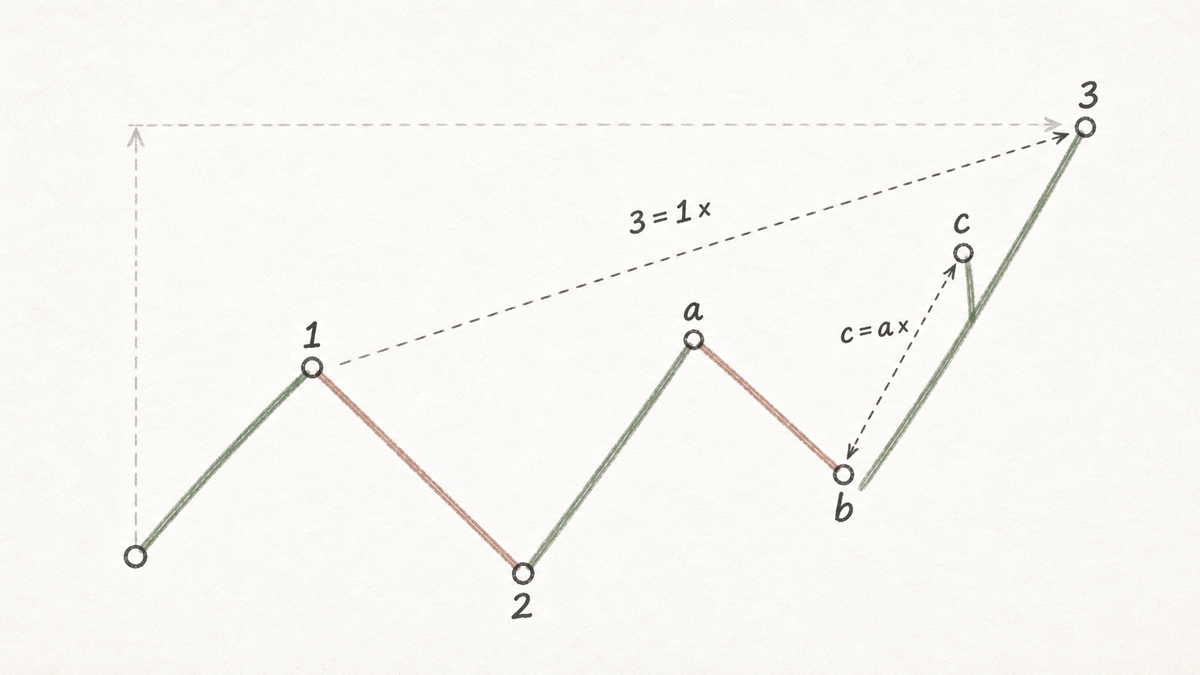
Wave 3 is measured against wave 1. Multiplying wave 1's length by the ratio gives wave 3's expected length. The whole preceding move or some other leg is not used as the denominator. Adding that value to the wave 2 low gives the expected price zone for the end of wave 3. Here the form of the additive ratio carries meaning. 176.4% is the distance of passing once fully through wave 1 (100%) and adding 76.4% of wave 1 on top. The additive ratio directly represents a move that fills out the width of the preceding impulse once and then adds a deep retracement's worth on top of it.
Orthodox Elliott handles the case where wave 3 stretches long past wave 1 with a separate concept called "extension." HEW does not keep extension as a separate thing and instead handles it with the same additive ratio set. Whether wave 3 is 1.764 or 2.236 times wave 1, both are one value on the same grid. HEW handles the degree of extension with a single ratio and no exception rule. The two methods split on this: where orthodox Elliott keeps a separate device, HEW consolidates it into a single ratio.
Wave c Projection — Measured Against Wave a
Wave c projects from 85.4% to 161.8% of the a within the same impulse, multiplying a's length by the ratio from the point where b ends.
Dropping one degree lower, wave c inside an impulse joins by ratio to wave a inside the same impulse. The wave c projection set that Copsey says he sees often is 85.4%, 95.4%, 100%, 105.6%, 109%, 114.6%, 123.6%, 138.2%, and 161.8%. c usually sits between the same length as a (100%) and 1.618 times a. Values around 100% (85.4, 95.4, 100, 105.6, 109) cluster in the middle of the set, which means it is most common for c to end at a length similar to a.
Wave c is measured against wave a within the same impulse. From the point where wave b ends, a's length is multiplied by the ratio and projected. For example, if c is 100% of a, the projection is a's length from where b ended; if c is 161.8% of a, the value projected by 1.618 times a's length becomes c's expected ending price zone.
Wave c projection differs in degree from wave 3 extension measurement. Wave 3 extension is the work, one degree up, of comparing impulse wave 3 against impulse wave 1; wave c projection is the work, one degree down, of comparing the c inside an impulse against the a inside the same impulse. The two measurements differ only in degree and follow the same logic of comparing one wave against another wave of the same kind. When two projections of different degree like this point together at the same price zone, the count is verified. This point is taken up later under cross-confirmation.
The Measurement Principle — One Wave Against Another
Copsey rejects the vague measurement of "a % of the whole preceding move" and always compares one wave directly against another wave.
A single principle runs through every measurement method so far. HEW's ratios always compare one wave directly against another wave.
- Wave c is compared against wave a.
- Wave 3 is compared against wave 1.
- Wave 4 against wave 3, and wave b against wave a.
Copsey points out that orthodox practice uses the vague measurement of "what percent of the whole preceding move." He raises as a problem that, in measuring wave 5, it is unclear "whether it is 23.6% of the whole move from the start of wave 1 to the end of wave 3, or 138.2%." If the same wave can be measured as either 23.6% or 138.2% depending on what you take as the denominator, that ratio cannot verify the count. Because once the denominator wobbles, any stopping point can be fit to some ratio after the fact.
HEW removes this ambiguity by fixing the reference wave to a single one. Because a specified single wave is compared against another single wave, the measurement is consistent. The whole move is not taken as the denominator. With the rule fixed that c is compared against a and wave 3 against wave 1, two people measuring the same count get the same denominator and the same ratio. For ratio to become a tool that verifies the count, the denominator must first be fixed. The measurement principle fixes that denominator.
Cross-Confirmation Is the Verification Discipline
A count holds only when the ratio projections of several degrees confirm one another at a single price zone.
Here is why HEW's ratios are not merely a target-price calculator. Copsey's verification discipline is cross-confirmation. A single ratio projection on its own does not settle the count. The count holds when projections of different degree gather at the same price zone and confirm one another.
In Copsey's terms, wave c must join wave a by ratio, wave iii must join wave i by ratio, and the target that the c within wave iii points to must also point to the same zone. When a projection of one degree and a projection of another degree overlap at a single price zone, that zone becomes the expected ending zone. This convergence of several ratios pointing together at the same spot is the grounds for the count.
Copsey describes this cross-confirmation as a device that "reduces the subjectivity of Elliott." Where orthodox Elliott labels as it appears, HEW accepts only the counts that pass the mutual confirmation of ratios.
Cross-confirmation has verifying power because the two projections are independent of each other. The wave-1-based wave 3 projection and the a-based c projection differ in both their starting wave and their degree. If the count were wrong, there would be no reason for the two projections to gather at the same price zone. So when the two values overlap at one zone, that agreement is hard to put down to chance. The very fact that two distances measured from different starting points point to the same spot becomes the grounds for the count. Conversely, if there is only one projection and no projection of another degree to confirm it, HEW leaves that target as only a provisional value. A single projection does not settle the count.
The reason for gathering ratios from three sources becomes clear here too. The denser the grid, the higher the probability that two or more projections point to the same value at one price zone, while at the same time the risk of accidental overlap is controlled. The grid that the Fibonacci residual ratios, the √2 values, and the additive ratios build together must be dense enough to catch the convergence of projections of different degree. That the ratio sources are three, and that cross-confirmation is the verification discipline, are two faces of a single design.
A Worked Example — Two Paths Converging on One Price Zone
Let us follow, in a hypothetical bullish count, the process of two ratio paths pointing together at the same price zone.
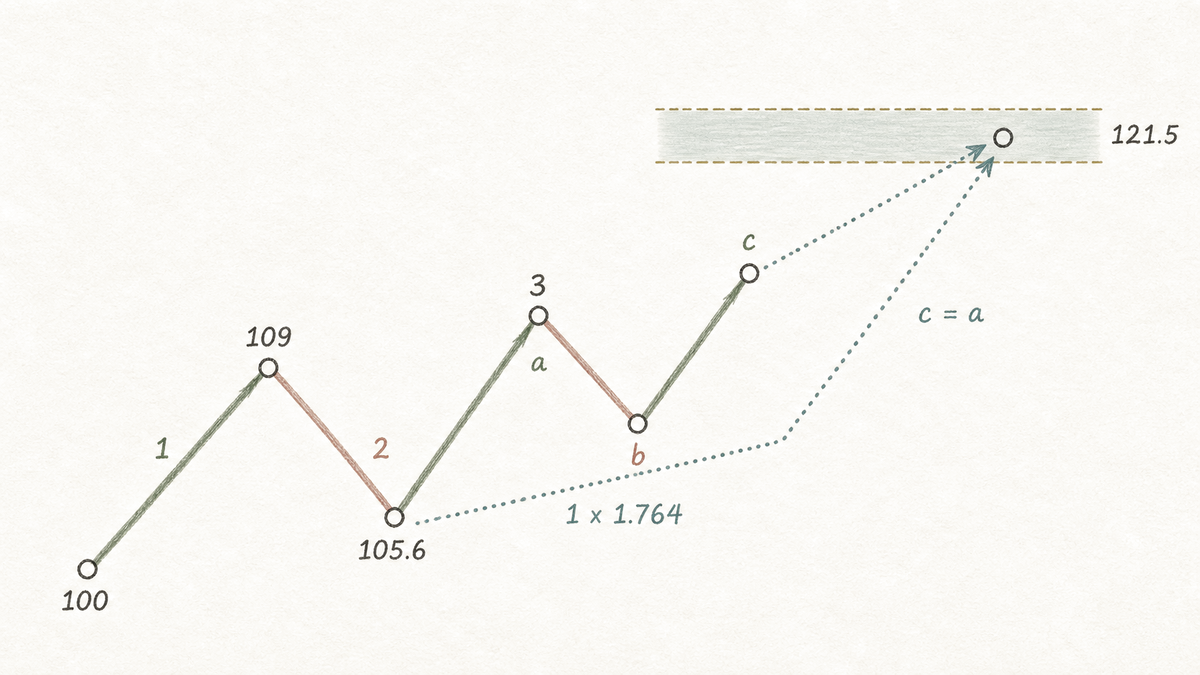
Let us look at measurement and cross-confirmation as one flow. Say wave 1 rose from 100 to 109, a length of 9.
- Wave 2: retraces 38.2% of wave 1's length. 9 × 0.382 ≈ 3.4, so subtracting 3.4 from 109 it halts near 105.6. The retracement is measured against wave 1's length.
- Wave 3: unfolds by 176.4% of wave 1's length. 9 × 1.764 ≈ 15.9, so adding it to the wave 2 low of 105.6 points near 121.5.
- The c within wave 3: measured against the a within the same wave 3. If c is around 100% of a, the value is the projection of a's length from where b ended. If this value also gathers near 121.5, then the wave-1-based projection and the a-based projection — two different paths — point together at the same price zone.
- Wave 5: projects 0.5 to 0.764 times the span from the start of wave 1 to the end of wave 3. Adding more than half of this span to the point where wave 4 ends gives the expected ending zone.
The grounds for the count are that the wave-3 projection measured against wave 1 and the c projection measured against a gather at the single price zone of 121.5 — that is, the convergence of the two ratio paths. Whether the individual numbers match to the decimal is a secondary matter.
Changing the ratio in this example makes the workings of verification clearer. If we assume the same wave 3 at 185.4% of wave 1, then 9 × 1.854 ≈ 16.7, and the expected ending shifts to near 122.3. If the c projection still points to 121.5 at this point, the two paths diverge, and that divergence is a signal that one of the two counts is wrong. The counter adjusts the ratio candidates so the two projections meet again at one zone, or re-examines the wave labels themselves. This adjustment process is the actual working of the statement that ratio verifies the count. It is a loop of picking one ratio, checking whether its value meets a projection of another degree, and doubting the count if it does not.
Relaxed Orthodox Rules
Because the impulse has the character of a diagonal triangle, several of orthodox Elliott's absolute rules do not apply as-is in HEW.
Because HEW is a modified version of Elliott, it keeps most of the skeleton. A few rules change because of the premise that the impulse is three waves.
- Overlap of waves 1 and 4: orthodox Elliott forbids wave 4 from entering the price territory of wave 1. HEW does not keep this prohibition as an absolute rule, because Copsey's structure starts from the diagonal triangle, and the diagonal triangle is a form that permits overlap of waves 1 and 4. In an HEW count, slight overlap is not an invalidation signal.
- Deep wave b: because the b inside an impulse is a genuine three-wave correction, it can retrace deeply. Even a spot where orthodox counting would read the trend as broken, HEW reads as a normal leg.
- Rejecting the failed fifth and the pile-up of extensions: orthodox Elliott corrects for disagreement with reality using devices such as the "failed fifth" and the "extended wave." Copsey views such devices as clutter arising from the wrong subdivision. Whether something extends is handled by ratio, with no separate rule.
These relaxed rules are one package with the ratio system. Where orthodox Elliott patched rule violations with exception devices, HEW substitutes the cross-confirmation of ratios. Even if waves 1 and 4 overlap, even if b retraces deeply, it does not discard the count as a rule violation. Instead it looks at whether the ratio projections gather at one price zone. Filtering by ratio what used to be filtered by rule is the essence of running HEW. So if you do not understand the ratio system, the relaxed rules look like arbitrary exceptions, and if you do understand it, it becomes clear that the two come from a single logic.
[Part 3] covers the structure of corrections, which grew in number as the impulse was changed to three waves. It examines the forms of corrections, the deep wave b, the alternation of waves 2 and 4, and how the determination of degree decides half the count.