OptiNod Academy
Harmonic Elliott Wave (Part 3) — The Structure of Corrections and the Deep Wave b
The correction slots that grew as the impulse became three waves. This covers the forms of corrections, the deep wave b, the alternation of waves 2 and 4, and the determination of degree.
As the impulse becomes three waves, the slots for corrections also grow from two to five. In HEW, how you read corrections decides half the count.
[Part 1] covered the single modification by which HEW reads the impulse as three waves (a-b-c), and [Part 2] covered the ratio system that joins those waves. Both parts focused on the trend-leading impulse. Changing the impulse to three waves also grows the slots for corrections. In orthodox Elliott there are two corrections, waves 2 and 4, but in HEW, adding the b wave inside each impulse, there are five slots. Part 3 covers what forms those corrections unfold in, how to read HEW's signature deep wave b, and how ratio and degree apply to corrections.
Corrections Are Half the Count
When the impulse becomes three waves, the slots for corrections grow from two to five.
In orthodox Elliott, a single trend cycle has two corrections, waves 2 and 4. In HEW, since each impulse wave 1, 3, and 5 unfolds as the three waves a-b-c, the b wave among them is in every case a corrective leg. The correction slots grow to five: b-of-1, wave 2, b-of-3, wave 4, b-of-5. This pairs with the trend-leading a and c growing to six slots.
As the correction slots grow, so do the points where you must determine the form of the correction when reading a count. To read the impulse precisely but skim the corrections is to leave half the count blank. Corrections are also the spot where the count splits. The same down-leg can be read as a wave 2 correction of a small degree, or as a correction of a larger degree. Only by determining the form and depth of the correction precisely can you decide which stage of the trend that leg belongs to.
The Forms of Corrections
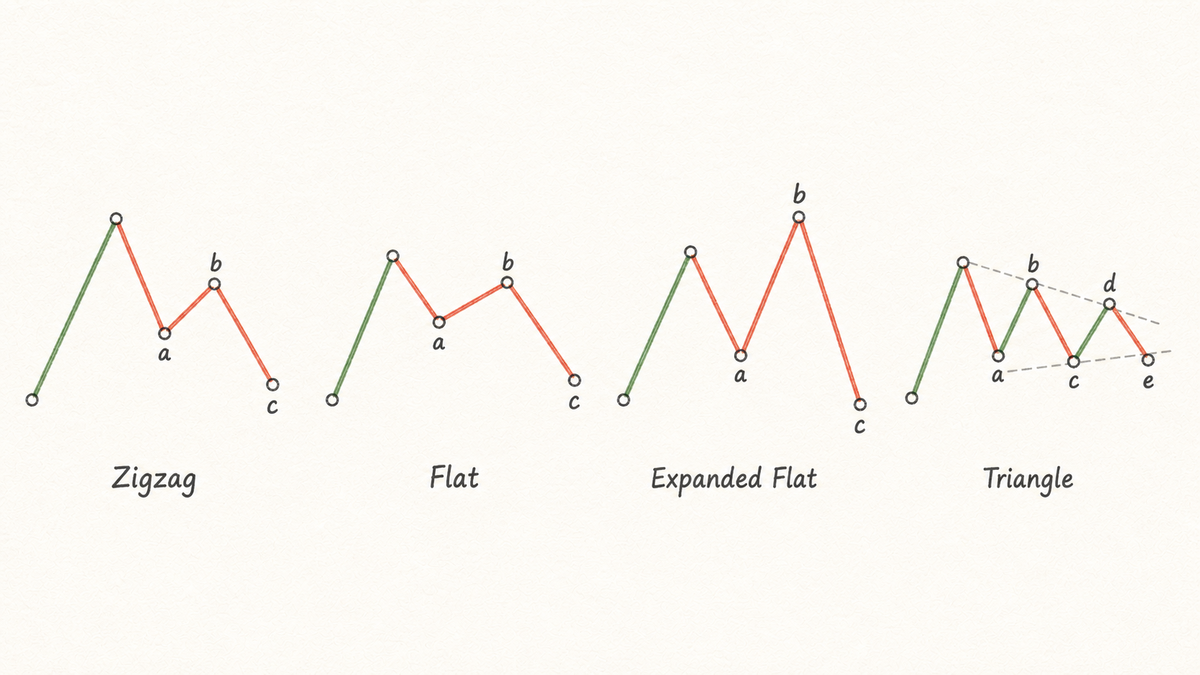
HEW uses Elliott's correction forms as-is: zigzag, flat, triangle, and combinations of these.
HEW changed only the subdivision of the impulse and keeps Elliott's correction forms. Corrections unfold broadly along four lines.
- Zigzag: an a-b-c correction that retraces the trend steeply. b retraces a shallowly, and c proceeds deep beyond a. It is a correction that breaks sharply relative to the trend.
- Flat: an a-b-c correction that runs long sideways. b retraces almost all of a, and c finishes near the end of a. It is a form that drags out time without retracing the trend deeply.
- Expanded flat: a variant of the flat. b retraces deeply enough to pass beyond the start of a, then c proceeds beyond the end of a. It is a form that appears often in HEW's handling of the b wave.
- Triangle: a correction in which the five nodes a-b-c-d-e converge, narrowing gradually. It appears mainly in the final leg of a wave 4 or a larger-degree correction.
- Combination: a correction in which two or three of the forms above join end to end. It appears when a correction does not finish in one go but runs long sideways.
In HEW all these forms are read on the three-wave skeleton, and the retracement depth is measured with the ratio set covered in Part 2. Whatever the form, a correction is checked for whether it ends near 38.2%, 41.4%, 50%, 58.6%, 61.8%, 76.4%, or 85.4% of the wave being retraced.
The clues that separate the forms are the slope relative to the trend and the depth of b. A zigzag breaks steeply relative to the trend and b is shallow. A flat runs long sideways and b retraces almost all of a. An expanded flat splits from an ordinary flat at the spot where b passes even beyond the start of a. A triangle is distinguished at a glance by its converging form of five narrowing nodes. A combination is suspected when, after one form finishes, the trend does not immediately resume but another correction is appended. Narrowing the form first also narrows down which ratio the retracement will end at.
The Deep Wave b
The b inside an impulse is a genuine three-wave correction, so it can retrace deeply. It is a spot easily misread, by the orthodox method, as a break from the trend.
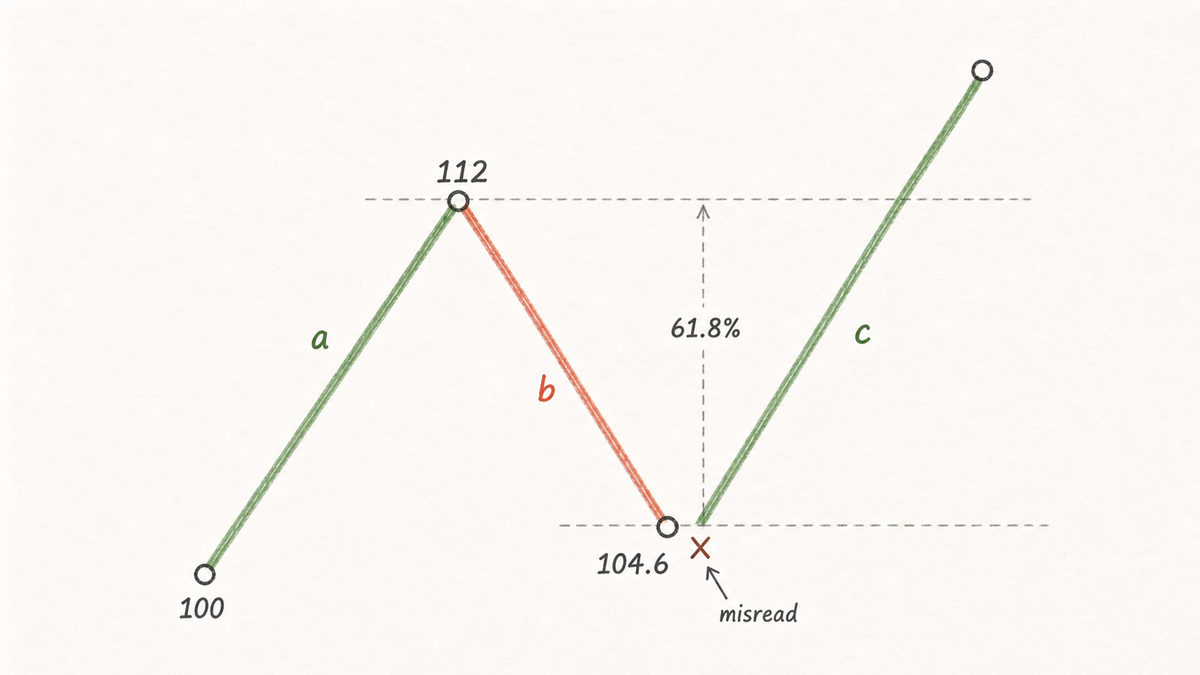
The spot most often misread in HEW is the b wave inside an impulse. Since impulse waves 1, 3, and 5 are the three waves a-b-c, the b among them is a genuine correction retracing a. This b sometimes ends shallow but can also retrace deeply. Copsey cites a case where b retraced 61.8% of a. By the orthodox Elliott method it is easy to see this depth as a sign that the trend has broken and to discard the count. In HEW, even if b retraces deeply, the impulse a-b-c is still valid. When c proceeds beyond a, the impulse completes normally.
Reading the deep wave b as normal is the practical difference that separates HEW from orthodox counting. By the orthodox method, when a deep retracement appears, you take the five-wave impulse to have broken and rebuild the count. In HEW you leave the same leg as a normal correction, on the premise that the b inside a three-wave impulse can be deep. It has the same root as not keeping the overlap of waves 1 and 4 as an absolute prohibition ([Part 2]). Because the impulse has the character of a diagonal triangle, both its internal b and the wave 4 between impulses permit deep retracements.
The criterion for the call is whether the structure resolves. Even if b is deep, the impulse is valid if c crosses back beyond a and continues the trend. If, after b passes beyond the start of a, no trend-direction continuation appears, then it is hard to read it as an impulse. Rather than discarding the count on depth alone, you also look at whether the following c resolves the structure.
The numbers make it clear. Say impulse wave 1 starts at 100 and a rises to 112. If the following b retraces 61.8% of a, it falls by 7.4 — 61.8% of 12 — coming down near 104.6. By the orthodox method it is easy to read this deep retracement as a sign that wave 1 has ended and the trend has turned. In HEW this is the normal retracement of the b inside impulse wave 1. When c then rises again from 104.6 and crosses beyond the end of a at 112, the a-b-c package completes as impulse wave 1. The same spot of 104.6 is read by the orthodox method as the end of the trend, and by HEW as the trend in progress. This difference of interpretation splits the whole count.
Alternation
Waves 2 and 4 alternate in form and depth. If one is steep, the other is long sideways.
Alternation is the observation that two corrections within the same trend take on different characters. If wave 2 retraces steeply as a zigzag, wave 4 tends to unfold long sideways as a flat or triangle. If wave 2 is shallow and fast, wave 4 is deep and slow. Copsey says he re-applies this alternation to fit the structure in which the impulse has become three waves.
Alternation is a tendency. It is not always kept. Still, reading the form of wave 2 lets you gauge in advance what form wave 4 will take. If wave 2 was a sharp zigzag, then for wave 4 you do not first expect the same sharp correction but rather put a long, drawn-out sideways unfolding first. Reading alternation makes the work of determining a correction's form easier.
Ratios in Corrections
Corrections are verified by ratio just like impulses. They are measured against the wave being retraced.
A correction's retracement also follows the ratio system of Part 2 as-is. The basis of measurement is the wave being retraced. Wave 2 is measured as a percentage of wave 1's length, wave 4 as a percentage of wave 3's length, and b as a percentage of the length of a within the same impulse. The retracements that appear often are 38.2%, 41.4%, 50%, 58.6%, and 61.8%, and deep retracements such as 76.4% and 85.4% are also a normal range in HEW. That 41.4% and 58.6%, derived from √2, appear often as the halting points of corrections is a feature unique to HEW.
A correction's ratio is also subject to cross-confirmation. Whether a correction halted at 38.2% or at 61.8% decides whether that correction is a small-degree wave 2 or a larger-degree correction. The degree of a correction is settled only by looking together at the depth and form of the retracement and at whether the next impulse unfolds in line with the ratios.
Degree and Fractals
Corrections and impulses are both part of a larger structure. The same a-b-c skeleton repeats, changing degree.
The structure of HEW does not end at one degree. The single impulse (a-b-c) seen in Part 1 and the five waves inside it were two degrees. These impulses gather to form a single node of a larger-degree impulse, and that large impulse also unfolds as the three waves a-b-c. The same goes for corrections. A wave 2 of one degree, seen from a larger degree, is part of that degree's correction. It is a fractal structure in which the same skeleton repeats across degrees.
Determining the degree is the starting point of the count. The same price leg can be read as small-degree impulse waves 1, 3, and 5, or as a single wave a of a larger degree. Which degree you read it as changes the forecast of the next move. The grounds for determining degree in HEW are also ratio. You determine the degree by seeing at which degree the ratios between waves fit most consistently when a leg is counted.
If you misjudge a correction's degree, the impulse count above it all goes off. Mistaking a small correction for a larger-degree correction misreads the trend as ended; mistaking a large correction for a small one misreads an ended trend as continuing. This is why you look at a correction's form, depth, and ratio together.
Let us look at one situation. If a down-leg retraced only 38.2% of the preceding advance and halted, that shallow depth makes it likely a small-degree correction — that is, a wave 2 or 4 within a larger trend. If the same leg retraced 76.4% of the preceding advance, that depth suggests a correction one degree up. Retracement depth is the first clue for gauging degree. To this you add form and the ratios of the next impulse to settle the degree. Rather than concluding on depth alone, the order is to check which degree's ratios the subsequent unfolding fits.
Summary — Corrections Set the Degree of the Count
The impulse traces the trend, and corrections set the degree of the count.
In HEW, the single modification of reading the impulse as three waves grows the correction slots from two to five. To that extent, reading corrections moves to the center of the count. A correction's form (zigzag, flat, triangle, combination), the permission of a deep wave b, the alternation of waves 2 and 4, retracement ratio, and the determination of degree all jointly decide the validity of a count. Adding the structure of corrections (Part 3) to the subdivision of the impulse (Part 1) and the ratio system (Part 2) fills in all of HEW's concepts. At any spot, the criterion for the call is the same: looking at whether the ratios between waves confirm one another.
The impulse subdivision, ratio cross-confirmation, and correction structure covered across the three parts are displayed as-is in the Harmonic Elliott Wave tab of OptiNod's pattern analysis. The three sub-waves of each impulse are labeled 1.A, 1.B, and 1.C, and the price zones where waves 3 and 5 are likely to end are marked as expected ending zones when two different ratio projections gather into one zone. The criterion is the same when reading a count on screen: finding the spot where the ratios confirm one another.