OptiNod Academy
Ichimoku — Lagging Span and Last Month's Price
Hosoda's most important line: today's close shifted back 26 bars, judging whether the move is real by whether price has cleanly broken from where it sat a month ago.
The most important of the five lines
As we saw in Part 1, the Lagging Span (Chikou) is today's close plotted 26 bars to the left, into the past. Hosoda regarded this line as the most important of the five.
The reason lies in how it is built. The Conversion Line (Tenkan-sen), the Base Line (Kijun-sen), and the leading spans are all derived from the midpoint between a high and a low. The Lagging Span alone carries today's close unchanged. It is the only line of the five that sets the current price itself against the past, which is why it shows most directly whether the present is truly higher or lower than before.
In the English-speaking world this line gets the least attention. Most traders simply check whether the current price is above or below the price 26 bars ago and leave it there. That falls well short of how Hosoda used the Lagging Span.
The line that sets the current price against the price a month ago
Because the Lagging Span is today's close shifted back, saying the Lagging Span sits above the bar from 26 bars ago is the same as saying today's close is higher than that bar. It looks like one more line on the chart, but at heart it is a device for comparing the current price and the price 26 bars ago at the same height.
The bar from 26 bars ago is the reference for a reason. Compare against yesterday or two days ago and minor wobbles throw you off. On the daily chart, using the price 26 bars, roughly a month, ago filters out short-term noise and shows whether the trend has stepped up a level.
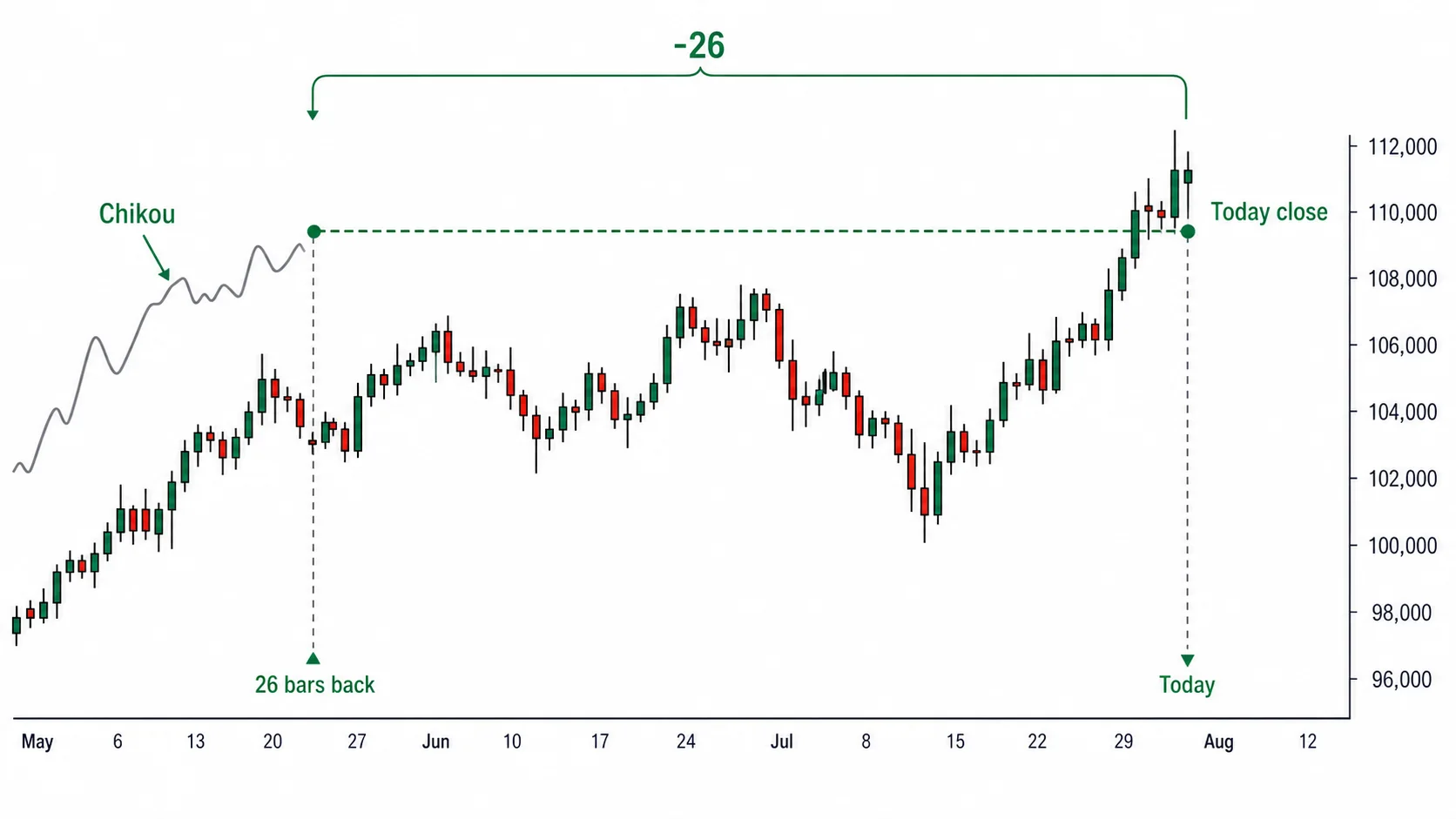
Reading the entire price range of the bar 26 bars ago
The English-speaking approach treats the price 26 bars ago as a single point. Hosoda's original method looks wider: it reads the entire price range of the bar 26 bars ago, from its high down to its low.
If you look at a single point, the signal fires the moment the current price edges just past the close of 26 bars ago, and it flips on the smallest move. Checking whether price has cleared the bar's entire range means it has fully left the territory that bar covered, which is a far firmer confirmation.
When the Lagging Span (Chikou) rises cleanly above the price range of the bar 26 bars ago, it is a buy signal; when it drops below, it is a sell signal. While it stays caught inside the range, it is neither. The market is failing to commit to a direction from the same place it stood a month ago.
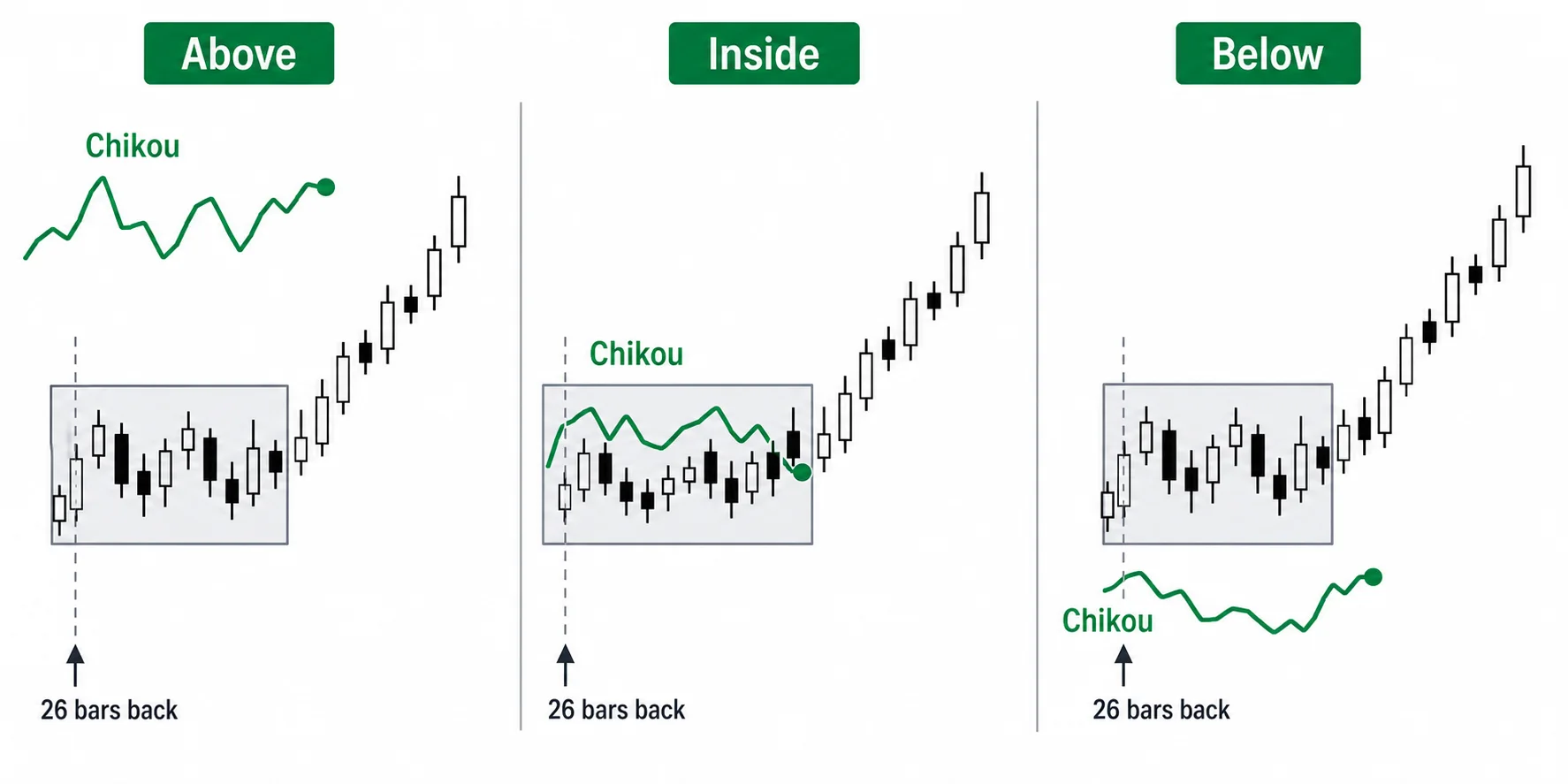
Is there anything overhead blocking the way
Watch, too, how the past candles sit at the spot 26 bars ago that the Lagging Span passes through. If a large candle or heavy trading is stacked there, that is supply left overhead of the current price. For the present move to push up, it has to clear that supply.
If the Lagging Span (Chikou) is caught inside that supply zone, the current price is likely to stall, however good it looks. If instead the spot 26 bars ago is empty and the Lagging Span floats free of obstruction, there is nothing overhead to block it and the move advances cleanly.
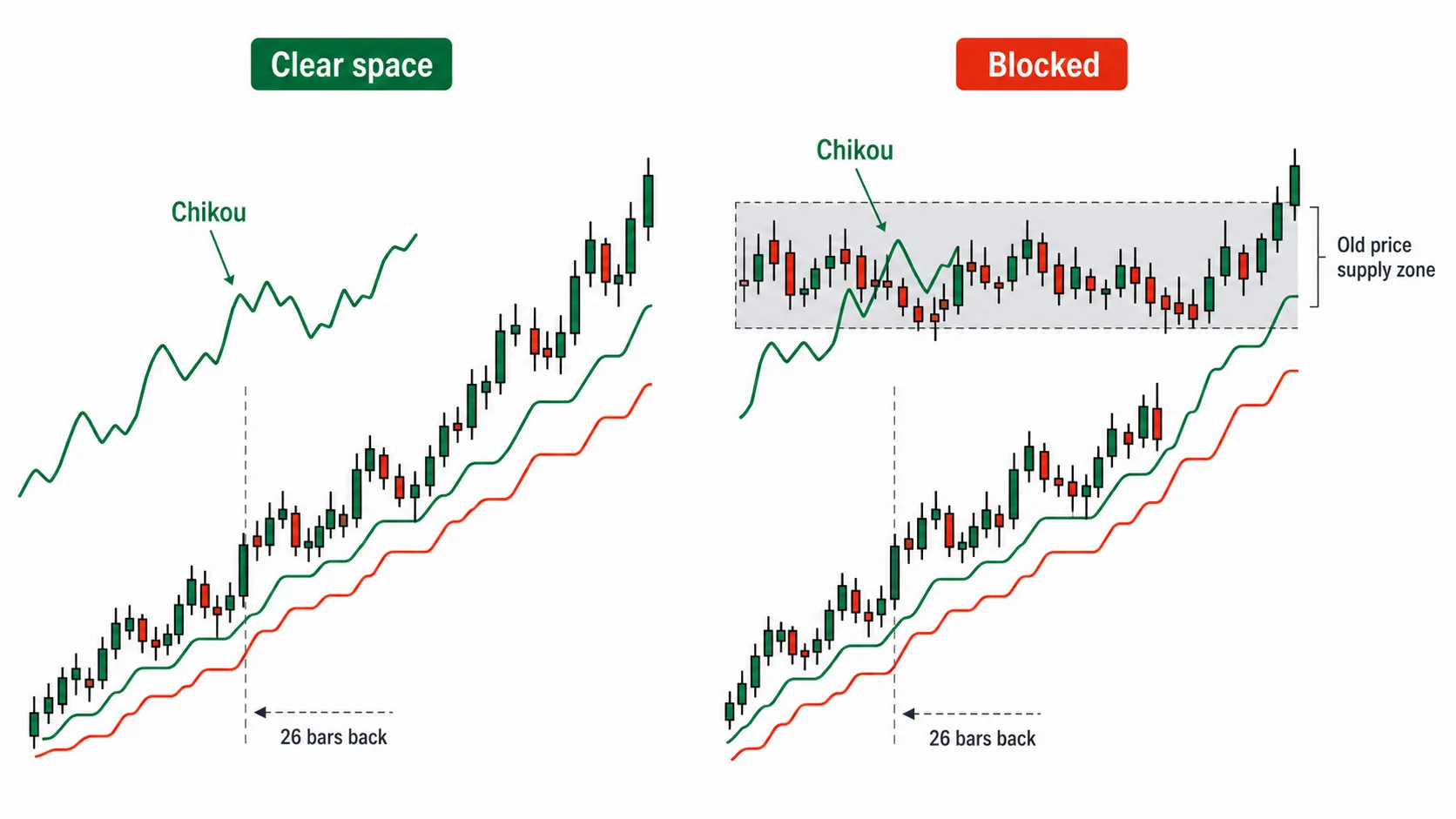
The candle to compare against sits 26 bars back
There is a common mistake when reading the Lagging Span: comparing it against today's candle, at the right edge of the chart where the line ends.
The Lagging Span (Chikou) has to be compared against the candle at the spot 26 bars back where the line is plotted. Using today's candle, where the end of the line lands, compares it against the wrong bar. When you turn the Lagging Span on, move your eyes to the left of the chart, to 26 bars ago.
However good it looks, if it is trapped the setup is incomplete
Price may have risen above the cloud (Kumo) and the Conversion Line (Tenkan-sen) may sit above the Base Line (Kijun-sen), but if the Lagging Span (Chikou) is trapped within the price range of 26 bars ago, the setup is incomplete by Hosoda's standard. The Lagging Span breaking free of that range is the final condition.
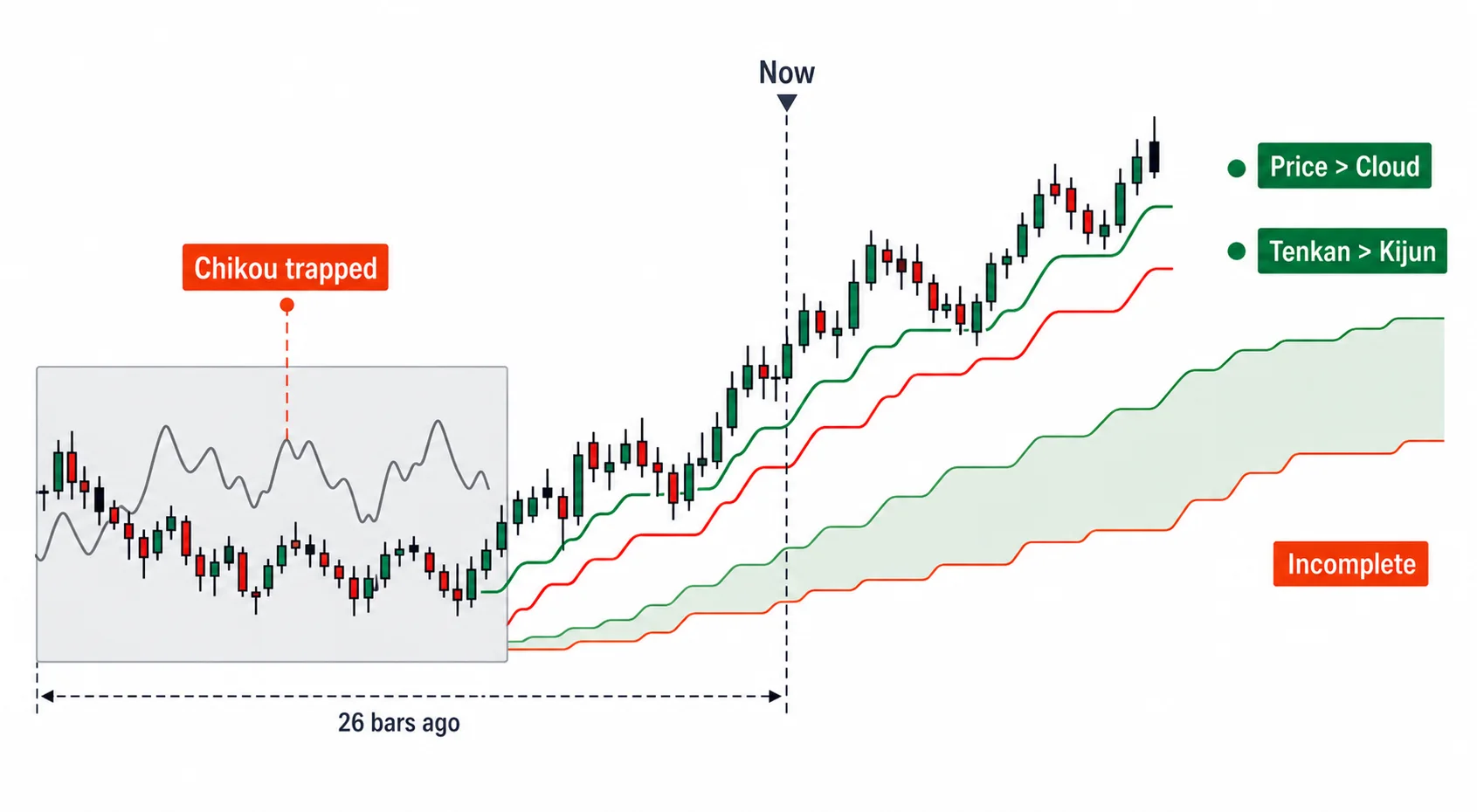
If the bar 26 bars ago was a large bullish candle, the Lagging Span takes a few more days to break out above it. The entry comes later, but stepping in slightly later this way is actually the safer timing. Breakouts entered without confirmation from the Lagging Span often run into the price range of 26 bars ago and reverse.
A short reads the same way, with only the sign reversed. When the Lagging Span (Chikou) drops cleanly below the price range of 26 bars ago and price is below the cloud with the Conversion Line below the Base Line, you have a bearish setup.