OptiNod Academy
Ichimoku — Three-Role Reversal
A bullish turn fires separately at the Conversion Line, the Lagging Span, and the cloud. Only Sanyaku is strong: wait for all three to buy, exit on any one reversal.
A bullish turn does not switch on in a single place. When the Conversion Line, the Lagging Span, and the cloud all turn bullish on the same bar, that is the three-role bullish reversal (Sanyaku), and it is the only strong location in Ichimoku. Wait for the three-role reversal before buying, but exit as soon as any one of them turns bearish.
Start with the bullish and bearish turn
The bullish turn and the bearish turn begin with the position of the Conversion Line (Tenkan-sen) relative to the Base Line (Kijun-sen). When the Conversion Line rises through the Base Line from below, that is a bullish turn, a buy-side signal. When the Conversion Line falls through the Base Line from above, that is a bearish turn, a sell-side signal.
The Conversion Line is the midpoint line of 9 bars, and the Base Line is the midpoint line of 26 bars. As Part 1 showed, both connect the exact middle between the highest high and the lowest low of their period. The Conversion Line is the short-term center, and when it crosses above the Base Line, the medium-term center, the center of the short-term trend has risen above the center of the medium-term trend.
One point is worth making clear here. These two lines are not moving averages. If neither the highest high nor the lowest low is renewed over a 9-bar window, the Conversion Line holds in place and goes flat. Even if price rises and falls within that window, the midpoint stays the same as long as the high and low are unchanged. A moving average shifts a little with every new bar, but a midpoint line does not move unless the high or low is renewed. This stillness is the core difference between the Conversion Line and Base Line on one side and moving averages on the other, and it is the foundation laid in Part 1.
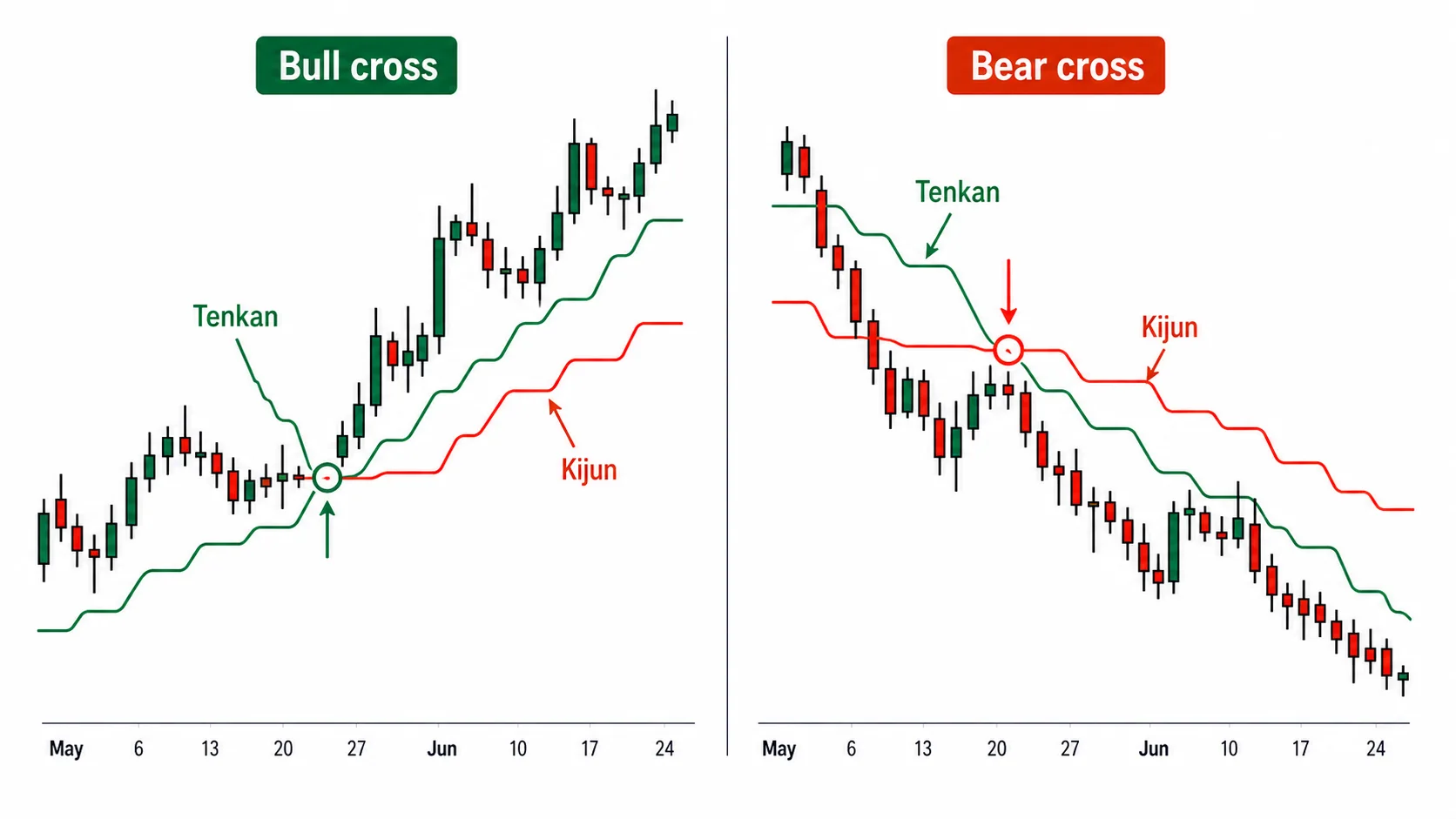
This much is the commonly known Ichimoku. Treating a single Conversion-Line/Base-Line cross as the whole of the bullish turn captures only part of what Ichimoku means by one.
A bullish turn switches on separately in three places
In Ichimoku, a bullish turn is not a single signal that fires in one location. It is defined separately in three different places. Because the three are grouped under one name, they are confusing at first.
Balance-chart bullish turn. The state in which the Conversion Line sits above the Base Line. This is the bullish turn produced by the Conversion-Line/Base-Line cross just described, and it means the short-term center has risen above the medium-term center.
Lagging Span bullish turn. The state in which the Lagging Span (Chikou) rises above the price 26 bars ago. The Lagging Span is the line drawn by shifting today's close straight back 26 bars. As covered in Part 3, when that line crosses above the price range of the bar 26 bars ago, that is a Lagging Span bullish turn. It confirms that the current close sits above the price at that point 26 bars earlier.
Cloud bullish turn. The state in which price rises above the cloud (Kumo). It means the cloud covered in Part 4 now acts as support, and that price has settled above the long-term center band.
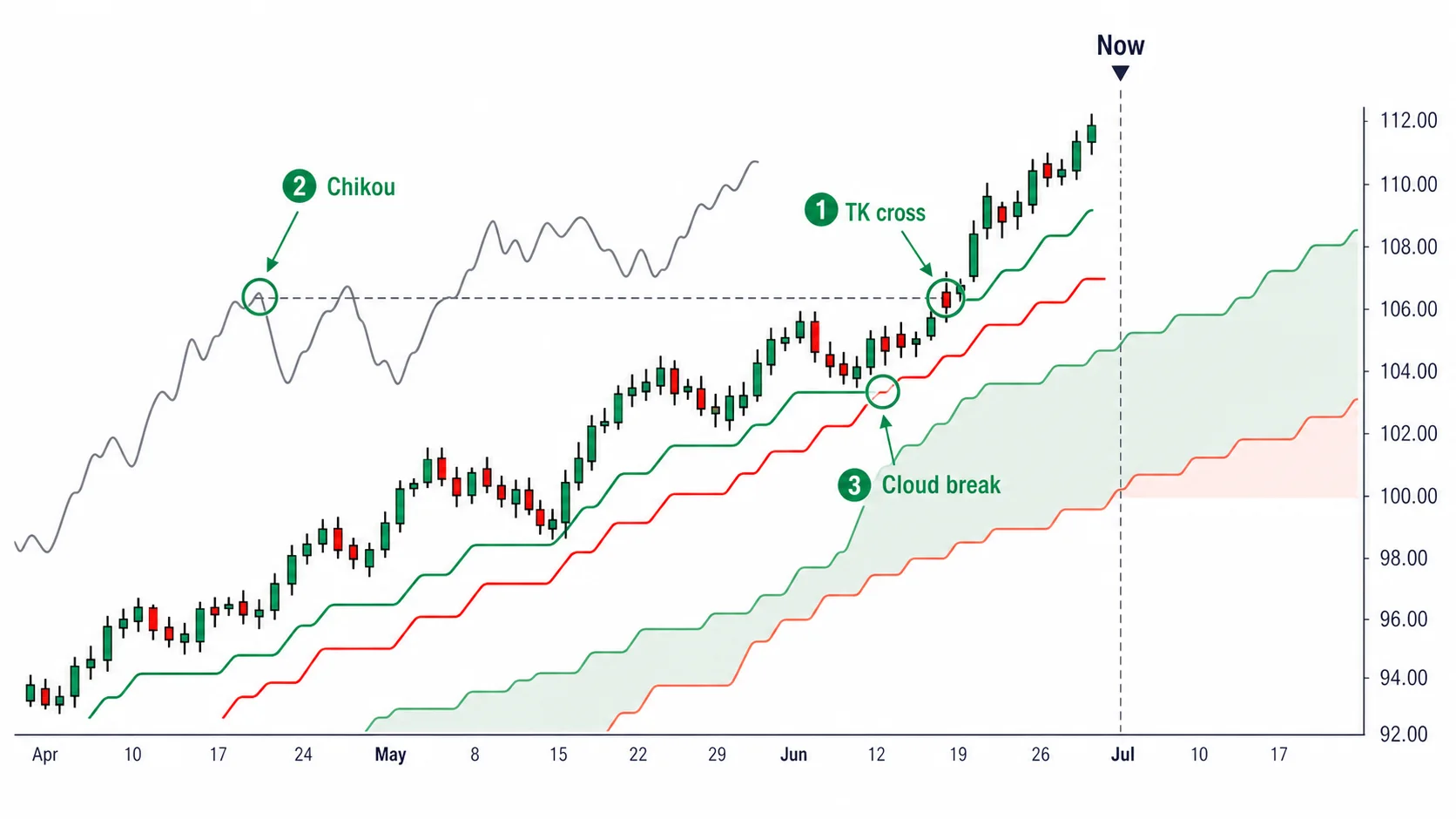
The three bullish turns look at different things. The balance-chart bullish turn looks at the relationship between the short-term and medium-term centers, the Lagging Span bullish turn at the relationship between now and 26 bars ago, and the cloud bullish turn at the relationship between price and the long-term center band. Reading Ichimoku's bullish turn properly means telling apart when the three point the same way and when they conflict.
To avoid confusing the periods of the lines with the numbers of time theory, one line of clarification belongs here. The 9 for the Conversion Line, the 26 for the Base Line, and the 52 for Leading Span B are the window periods of each line. The basic numbers of time theory — 9, 17, 26 — are a separate system for counting change days, where 17 comes from 9×2−1 and 26 from 9×3−1. The 52 of the line period is 26×2, the proper span for the cloud's Leading Span B, and it belongs to a different layer than the place where time theory uses 17.
The Lagging Span bullish turn separates contact from breakout
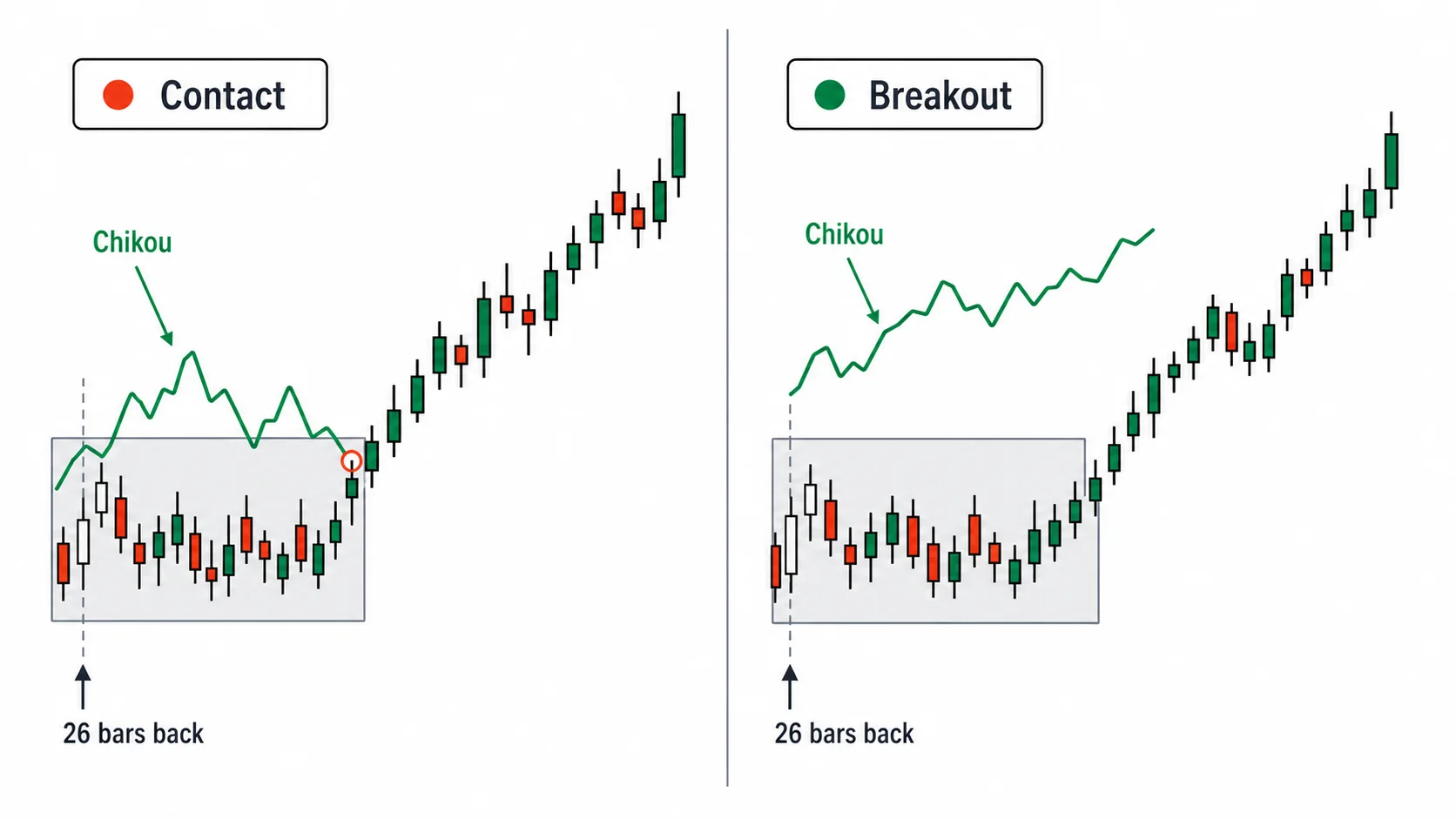
When reading a Lagging Span bullish turn, the first thing to check is whether the line has clearly cleared the price 26 bars ago. If the Lagging Span is lodged inside the candle body of the bar 26 bars ago, touching it, that does not count as a bullish turn. It only meets the price 26 bars ago at the same height; it has not risen above it.
The Lagging Span bullish turn becomes clear when the Lagging Span rises above the high of the bar 26 bars ago and settles in the empty space above that candle. The empty space ahead of the Lagging Span that Hosoda emphasized helps confirm this. When there are no price bars above or below the Lagging Span, the comparison with the price 26 bars ago is clean; when it is lodged inside a candle, the situation reads as a range.
The three-role bullish reversal is all three switching on in one bar
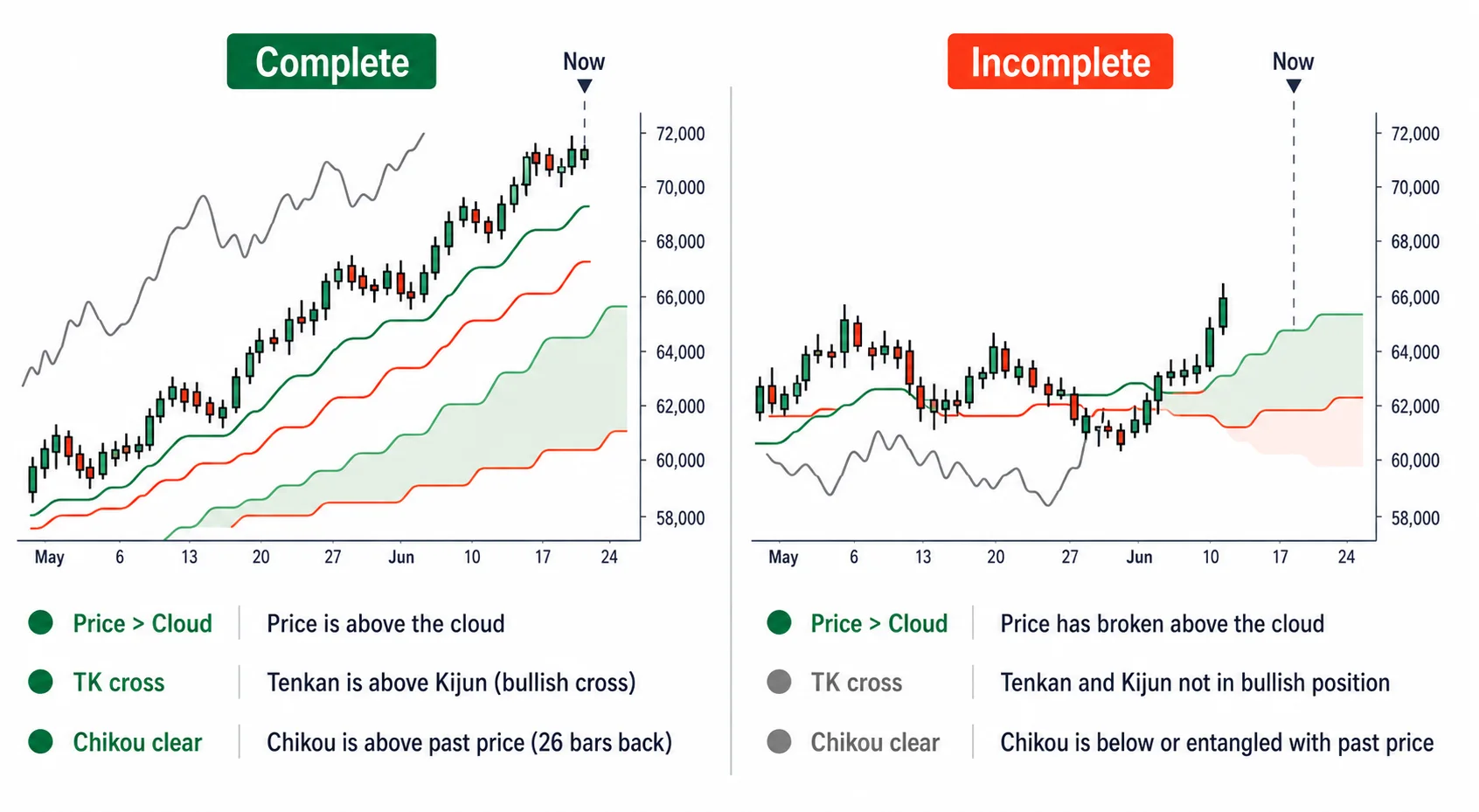
The three-role bullish reversal (Sanyaku) is the state in which all three bullish turns switch on at the same time on one bar. The three conditions are:
- The Conversion Line is above the Base Line (balance-chart bullish turn)
- The Lagging Span is above the price 26 bars ago (Lagging Span bullish turn)
- Price is above the cloud (cloud bullish turn)
All three must hold for a three-role bullish reversal. Price breaking above the cloud alone is not a three-role bullish reversal. That is only the cloud bullish turn switching on, and if the other two are not yet on the buy side, the market is pointing up in only one of the three time horizons.
The orthodox interpretation adds one further condition here. For the balance-chart bullish turn, it requires the Base Line to be rising, or at least flat. A cross in which the Base Line is falling while the Conversion Line briefly rises above it counts as a weak bullish turn. While the Base Line is falling, the center of the medium-term trend is still on the downside, so even when the Conversion Line rises above it, the cross often reverses quickly.
Read signal strength by how many have switched on
Defining the three bullish turns separately lets you score the bullish turn by how many have switched on. With no bullish turn at all, there is no buy-side basis. One switched on means wait; two switched on means prepare; all three switched on, the three-role bullish reversal, is the location for action.
The direction of the Base Line layers on top of this. When the Base Line is rising, the center of the medium-term trend is clearly on the upside, so a bullish turn appearing above it is a strong bullish turn. When the Base Line is flat, the medium-term trend has not chosen a direction, so the same number of bullish turns reads as weaker. The flat Base Line seen in Part 1 generally marks the center of a range, and a bullish turn appearing above it tends to end in frequent reversals.
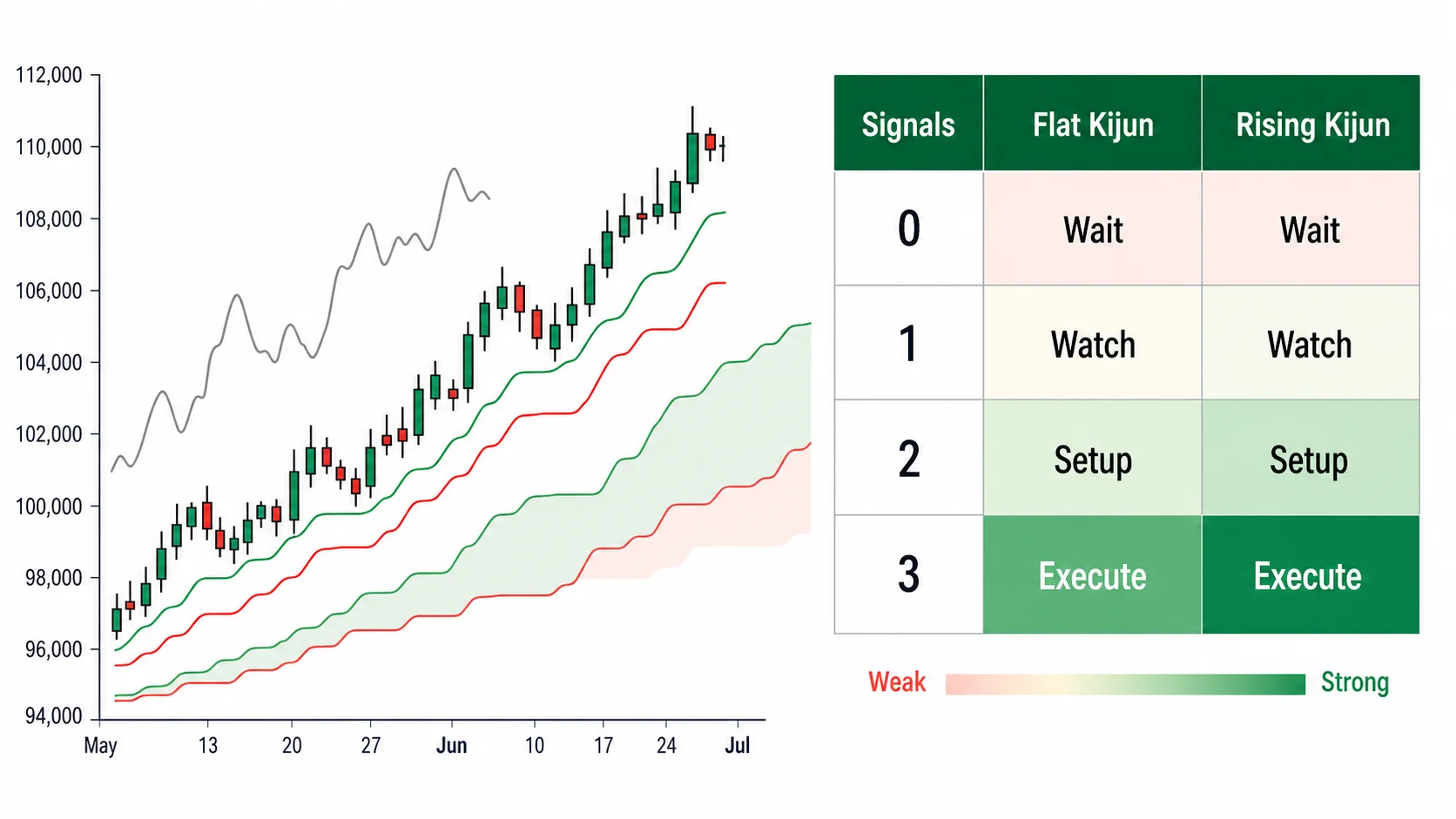
Even the same three-role bullish reversal carries different weight depending on whether the Base Line is rising or flat. A three-role bullish reversal that appears in a range where the Base Line is flat is graded down a notch even with all three switched on.
The three-role bullish reversal arrives slightly later
The three-role bullish reversal usually completes late. By the time the three bullish turns switch on together on one bar, price has often already risen a long way. The last condition to fill is usually the cloud bullish turn. The cloud is the long-term center band, so it is the thickest and the farthest away, and price takes time to climb that far.
There is also a typical order of appearance. The Conversion Line crosses the Base Line first, switching on the balance-chart bullish turn; then the Lagging Span rises above the price 26 bars ago; and finally price crosses the cloud. Filling them in this order — balance chart, then Lagging Span, then cloud — is common. This order does not always hold, and when the cloud is thin or close, it can reverse.
The drawback of the three-role bullish reversal completing late can be offset by building the order of appearance into the entry design. When the balance-chart bullish turn and the Lagging Span bullish turn are both already on, the only condition left is price crossing the top of the cloud. At that point, set the top of the cloud as a breakout buy-stop location. Entering the moment price crosses that line is an entry that chases and confirms the completion of the three-role bullish reversal. It is a way of staking out the location in advance, at the prepare stage where two bullish turns are on.
Wait to buy, but exit first
Ichimoku is strong in trending markets and weak in ranges. Given that nature, judging buying and exiting by the same standard is a losing approach. Running entry and exit asymmetrically fits better.
For buying, wait until the three-role bullish reversal completes. Waiting until all three bullish turns are on makes the entry late, but the location where all three line up is one where the short-term, medium-term, and long-term centers all point up, so the chance of being whipsawed is low. Entering on only one or two bullish turns is faster but often gets caught in the frequent reversals of a range.
Exiting is different. Do not wait until the three-role bearish reversal completes. As soon as even one of the three bullish turns bends to the sell side — especially when the balance-chart bearish turn appears first — reduce the holding. Defending against a bearish turn early is the more favorable approach.
Using the Base Line as a trend-following stop fits well here. Hold while the Base Line keeps rising and price stays above it. When the Base Line bends down, or price closes below the Base Line, treat it as a partial-exit signal. Because the Base Line is a midpoint line, its tendency to go flat when neither the high nor the low is renewed is an advantage here. The stop does not waver on small price swings, and the line only follows down when the medium-term center actually bends. Going in requires filling all three conditions; coming out moves on the breakdown of even one.
Filter out a bullish turn that appears in a range. In a window where the Base Line is flat, the Conversion Line rises and falls above and below the Base Line repeatedly, cycling through balance-chart bullish and bearish turns. Most of these crosses are fakeouts, and until the Base Line settles on a direction, a bullish turn that appears is not treated as a signal to act.
Shorting is the three-role bearish reversal
Shorting flips the buy logic up to this point straight over. The three-role bearish reversal is the state in which all three bearish turns switch on at the same time on one bar. The Conversion Line falls below the Base Line, the Lagging Span falls below the price 26 bars ago, and price falls below the cloud.
When all three conditions hold and the Base Line is falling, it is a strong bearish location. Price falling below the cloud alone is not a three-role bearish reversal. Just as with buying, all three places must switch on to the sell side.
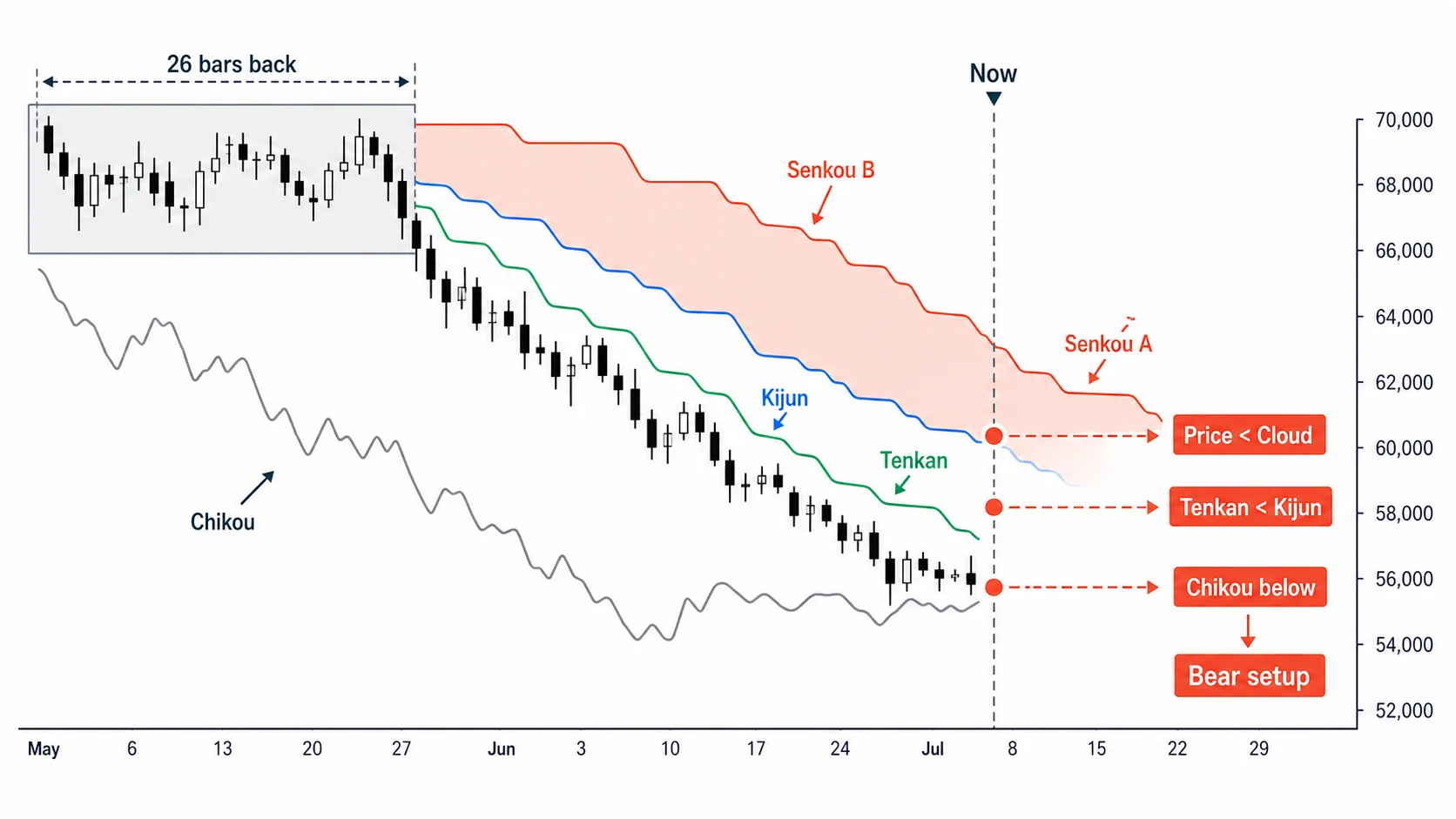
For a short entry, wait until the three-role bearish reversal completes; for a short exit or buy-side defense, react first on a single bullish turn. The standard for separating contact from breakout in the Lagging Span bullish turn, and the asymmetry between buying and exiting, apply the same way with only the direction flipped.