OptiNod Academy
There Is No Magic Strategy — Why a Formula That Makes Money Anywhere Does Not Last (1/3)
When you carry a setting verified on one symbol and one time frame over unchanged, why do losses appear? The first part of a three-part series, starting from why a formula that makes money anywhere does not last.
Many people search for a trading formula that makes money anywhere. Yet if there were a formula that made money on any symbol and any chart, that formula would soon stop working. This article explains why a setting that keeps making money in one place tends to have a narrow range of application.
This is the first of a three-part series. It explains why a trading setting that made money in one place produces losses when carried over, unchanged, to a different symbol or a different time frame. Part 1 covers why a formula that makes money anywhere does not last; Part 2, why losses appear when only the time frame is changed on the same symbol; Part 3, the problems that arise when moving to a different symbol and what to do at that point.
Many people go through this experience. They take a setting that made money on the one-hour Bitcoin chart for several months and apply it, unchanged, to the five-minute chart or to a different coin. Within a few days it produces losses. The analysis is the same and the numbers are the same, yet the result comes out the opposite way.
People move a setting like this out of a single belief: the idea that good technical analysis should make money regardless of symbol or time frame. With this belief, once a setting is found that fits well in one place, it is treated as a formula that can be used on every chart. But the result is mostly losses, and those losses have a clear reason.
There is a reason people want to believe in a magic formula
If a one-line formula that made money anywhere existed, trading would become very easy. Find it once, and you would only have to apply it to any coin on any chart. There would be nothing more to study and no need to look at each symbol again. Because this idea is appealing, many people believe such a formula exists somewhere and spend a long time looking for it.
Advertisements and courses work on this feeling. The phrase "just enter this setting and make money on any coin" appeals precisely to this belief. If the phrase were true, the seller could use it himself; there is another reason it is being sold instead.
Setting this belief aside is the starting point of this series. The wish for trading to become easier is natural, but wishing it were easier and actually making money are not the same thing.
A formula everyone knows loses its profit as more people copy it
For a single trade to make money, there has to be someone willing to buy at a higher price than the one I bought at. But when everyone sees the same signal and buys in the same place, all that buying happens at once and in advance, so price rises first. By the time the signal actually appears, the price has already risen and there is nowhere to buy.
A simple rule where two moving averages cross is a good example. After it appeared in a book decades ago, everyone came to know it, and now it is hard to make steady money from that one rule alone. Too many people watch the same crossover in the same way, so price moves before the crossover even forms. Once automated trading programs run the same rule as well, the speed at which a person checks by hand cannot keep up.
A condition that one person finds for himself by watching his own symbol and his own time frame for a long time is different: others are not watching it the same way, so it makes money for a while. The more widely a formula is known, the more its opportunity has already disappeared.
This is why a setting that makes money for a long time has a narrow range of application
Settings that make money for a long time share a common trait: the conditions for profit are demanding, so the setting is hard to copy. When the conditions are demanding, few people watch the same place, and the opportunity fades that much more slowly.
Suppose, for example, there is a movement on some symbol that appears only during the low-volume early-morning hours. This movement is known only to someone who has watched that symbol at that time for a long time. The conditions are demanding, so few people copy it, and for that reason it makes money for a while. Apply the same setting during the high-volume daytime hours, and many people are watching, so the same approach makes no money.
Turning this around leads to an uncomfortable conclusion. If a setting fits well on every symbol and every time frame, it means that many people are already watching that movement. The more widely it applies, the less it lasts. Finding a setting with a narrow range of application is no cause for disappointment. It is that very narrowness that lets the setting make money for a long time.
One good result and repeated good results are not the same
What people rely on when moving a setting is the test result. But one good test result does not make the setting good. Test many settings on many charts, and a few of them will produce good results purely by luck.
If a thousand people each flip a coin a hundred times, a few of them will get heads many times in a row. That person is not special. When there are many people, someone turns out that way. Make a hundred settings and test them on a hundred charts, and a few will show good results for the same reason.
So when you see one good result, the question to ask is why it came out that way. A result that came from a clear reason continues next time. A result that is merely good for no reason is chance, and once moved it returns to ordinary losses.
Moving the same numbers does not bring along the conditions that made them fit
What people carry over when moving a setting is the numbers: a stop-loss of a few percent, a moving average of so many days, an entry condition, and similar values. But the reason those numbers made money does not lie in the numbers themselves. It is because those numbers fit the movement of that market.
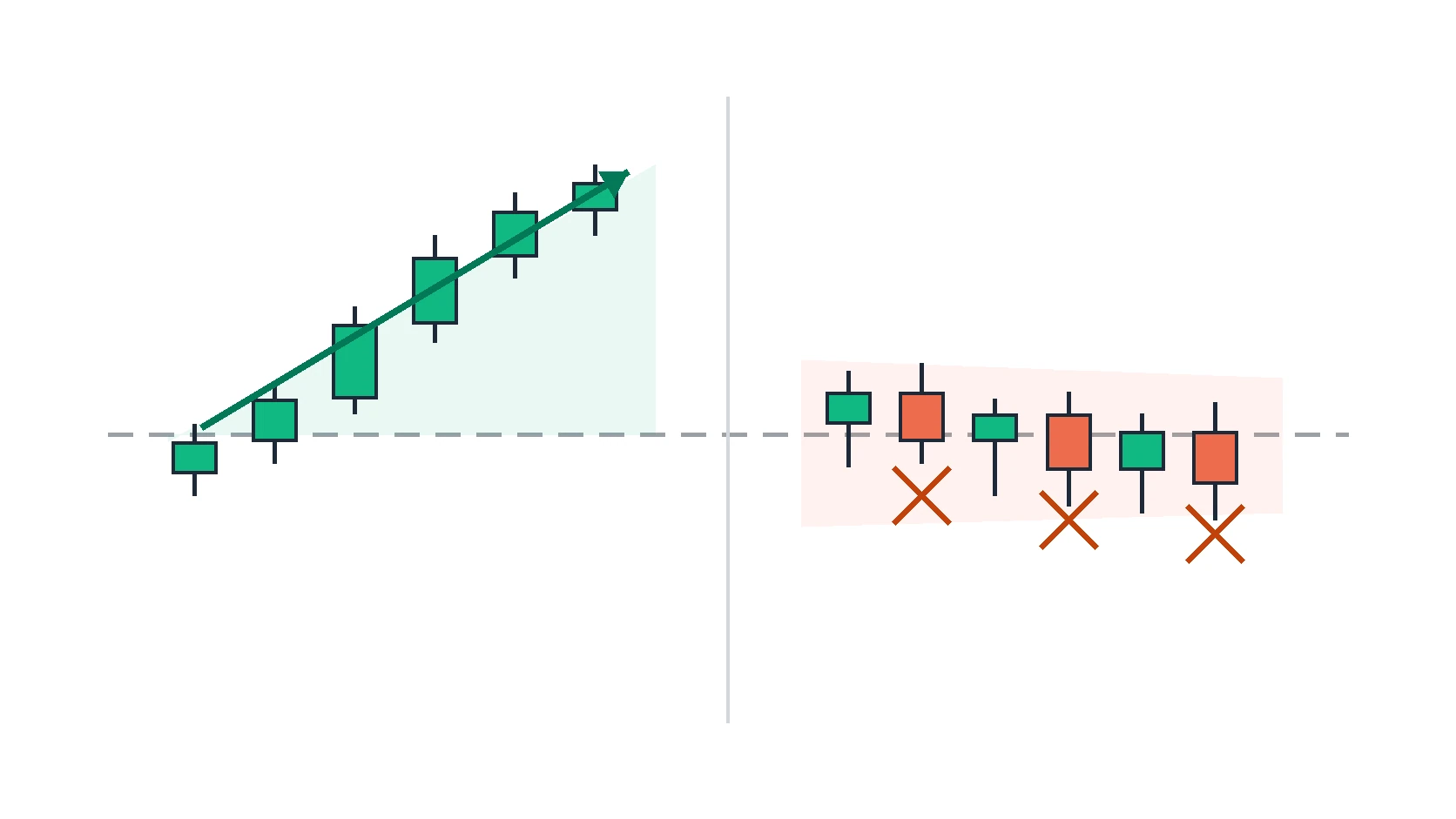
Consider a period when price rose in one direction for a long time. During such a period, a setting that buys on each small dip fits well. But when the market changes into a period of rising and falling within a narrow band, the same setting with the same numbers produces continuous losses. The "one-directional rising flow" that the numbers were tuned to has disappeared. The stop-loss and the entry condition are unchanged, but the market state they were tuned to has changed.
So what really needs to be carried over when moving a setting is the conditions the numbers were tuned to. Leave out these conditions and move only the numbers, and even a strategy that looks the same no longer makes money.
Being well tested and fitting everywhere are not the same
When a setting is tested at length on one symbol and one time frame and gives a good result, you come to trust it. That is the right attitude. Testing is essential. What being well tested tells you, though, reaches only as far as this: the setting makes money under the conditions it was tested in.
Mixing the two is dangerous. Look at a good result on the one-hour Bitcoin chart, conclude "this strategy is good," and the moment you extend that "good" to every chart, the losses begin. The range that testing speaks to is only as wide as what was tested.
If you have found a good setting, the next question to ask is "why did this make money here?" If you can answer this question, you check whether that reason is present under other conditions too and decide whether to move it. If you cannot answer it, the setting is one you should not move.
- The reason it made money: Write in one sentence why this setting made money on this symbol and this time frame. If you cannot write it, do not move it.
- Luck versus skill: Distinguish whether the good result came from a clear reason or appeared by chance after many tests.
- Are others watching it too: If it is a rule that appears verbatim in a book or course, suspect that the opportunity may already have disappeared.
The wish to move a setting that made money in one place to another place is natural. You want to use more widely what is working. But the more widely it applies, the less it lasts, and the longer a setting lasts, the narrower its range of application. So when you find a good setting, the first thing to do is to understand why it made money under these conditions. Move it without knowing that reason, and the moment you move it, losses appear. The next part explains what changes when the symbol is left in place and only the time frame is changed.