OptiNod Academy
There Is No Magic Strategy — When You Move to a Different Symbol, and What to Do (3/3)
Move numbers tuned to one symbol to a different coin, and why do you keep getting stopped out? The final part of a three-part series, explaining the different movement range and trading character of each symbol, and closing with what to do before you move.
Move the stop-loss and entry numbers tuned to one symbol, unchanged, to a different coin, and you keep getting stopped out. It is because the daily range and the people trading differ from symbol to symbol. This final part closes the series with what to do before you move a setting.
The previous two parts explained why a formula that makes money anywhere does not last, and why losses appear when only the time frame is changed on the same symbol. This part deals, finally, with the symbol. Leave the time frame in place and move only from Bitcoin to a different coin, and the same setting turns into losses — and once you understand the reason, you can see what to do.
The frame of mind in moving a symbol is the same as in moving a time frame. It worked on one coin, so you expect it to work on another. But each coin has a different character, so numbers tuned to the movement of one coin cannot play their role on another.
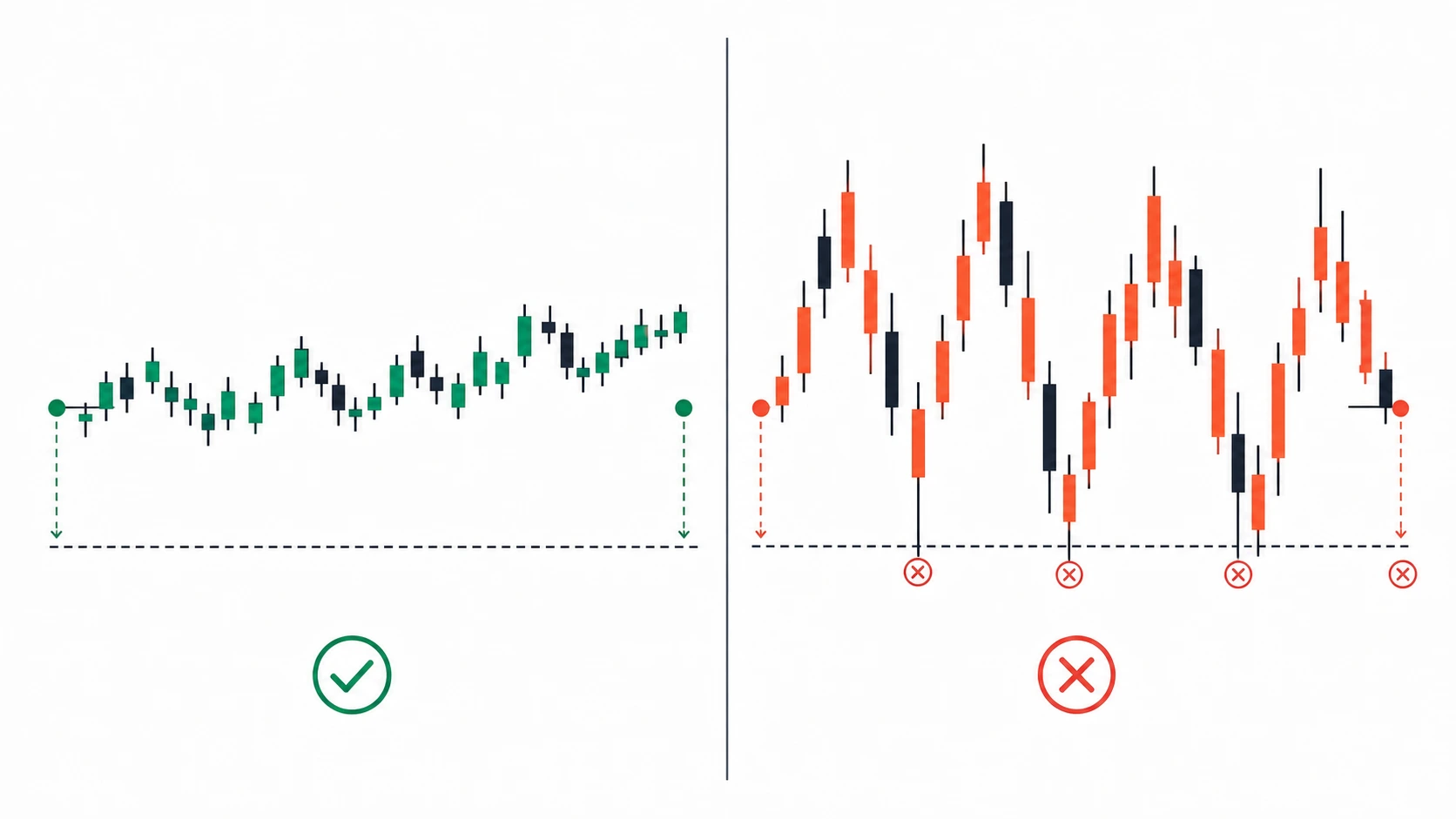
Each symbol rises and falls a different amount in a day
Each coin moves a greatly different amount in a day. Over the past two years, Bitcoin's daily range between high and low has been about 3 percent at the median, and days where the daily range exceeded 5 percent came roughly one in five. As a large symbol it has heavy trading, and the movement is correspondingly gentle.
A smaller coin is different. Moving 10 percent or 20 percent in a day is not rare. Because trading is thin, even a small amount of capital moves the price greatly. Even for the same "day," Bitcoin's day and a small coin's day differ several times over in range.
This difference turns a setting fixed in numbers into losses. A stop-loss of 5 percent that fit well on Bitcoin is a line Bitcoin touches only now and then. But move the same 5 percent to a coin that moves 20 percent in a day, and it gets stopped out often even on ordinary movement. The number is unchanged, but the range it was tuned to has disappeared.
Numbers tuned to one symbol are tuned to that symbol's range
Not only the stop-loss but the entry condition too is tuned to that symbol's range. The condition "buy when it falls 3 percent" is a meaningful dip on a symbol that moves 3 percent in a day, but on a symbol that moves 20 percent in a day it is just one piece of ordinary movement. The same 3 percent is a signal on one side and noise on the other.
Here the settings that can be moved and the settings that cannot are divided. A setting that carries a fixed percent over unchanged does not fit when the symbol changes. A setting that first measures how much that symbol usually moves and sets the number as a multiple of that range will, when the symbol changes, have its stop-loss distance grow and shrink along with that symbol's movement.
So when moving a symbol, you change the method for setting the stop-loss. Instead of writing down a fixed 5 percent unchanged, first measure how much that symbol usually moves in a day, then set the stop-loss as a multiple of that range. Done this way, the same one-line rule is calculated as a different stop-loss distance for each coin.
A thinly traded coin moves differently on the same signal
It is not only the range that differs. A thinly traded coin moves in a different way altogether. A large symbol has orders stacked thickly, so price moves step by step one notch at a time, but a thinly traded coin has gaps between orders, so it rises or falls greatly at once.
This difference changes the result of the same signal. A breakout that crosses a line smoothly on a large symbol jumps across that line in one step on a thinly traded coin. When you go to buy along with it, it is already far above, and it sometimes comes right back down. The rule "see a breakout and buy" that fit well on a large symbol often buys at a high price and produces losses on a thinly traded coin.
Who is trading also differs by symbol. A large symbol has several kinds of capital mixed together, so it does not move in only one direction, but a small coin that rises and falls on a single piece of news moves in one direction on that news. Even with the same chart analysis, the movement after a signal differs depending on who trades that coin.
Being strongly tested and fitting everywhere are not the same
Read this far, it can sound like a claim that testing is useless. It is not. Testing is still necessary, and strong testing and weak testing are clearly different. You only have to see precisely what strong testing means.
Strong testing means that even when you change the setting values a little, or vary the period a little, the result does not swing greatly. That it withstands small changes within one symbol and one time frame is a good signal. Fitting everywhere means it makes no distinction between symbols or time frames, and that is a signal to be suspicious of. As seen earlier, the more widely it applies, the faster its opportunity disappears.
So if you have found a good setting, you have to look at two things separately. One is how firm it is within those conditions; the other is how far it may be extended. The former is better the larger it is; the latter is more natural the smaller it is. The moment you mix the two and pass over to "it is firm, so it should work anywhere," the losses begin.
The real reason there is no magic formula is that the market does not hold still
Everything so far comes down to one line. Where money is being made in one place, people gather and make the same trade, and then the profit of that place disappears. Because this process happens endlessly, a formula that makes money everywhere forever cannot be built.
This applies equally to a setting that was making good money in one place. A setting that fits well now on the one-hour Bitcoin chart loses its effect as time passes and more people come to watch the same place. So to keep using one place, you have to check periodically whether the setting still makes money. The attitude of testing once and believing forever has the same root as believing in a magic formula.
In the end, what matters is not a universal formula. It is knowing why your own setting makes money, and using it in that place while the reason is still alive.
- That symbol's range: First measure how many percent the coin you are moving to usually moves in a day.
- Resetting the numbers: Do not move the stop-loss and entry condition over as a fixed percent; reset them to fit that symbol's range.
- Order depth: If it is a thinly traded coin, account for the fact that it moves greatly at once, and be more careful with settings that buy on a breakout.
- Period of validity: Check even a setting that made money once at intervals, to verify that the number of people watching the same place has not grown.
The idea that good technical analysis makes no distinction between symbol or time frame is pleasant to hear. If it held, you could make money anywhere with a setting found once. But the real market moves the other way. The longer a setting makes money in one place, the more firmly it is tuned to those conditions, and the more a formula is known to make money everywhere, the more its opportunity has already disappeared. So the thing to do when you find a good setting is clear. Before looking for where else to use it, find out why it made money on this symbol and this time frame. Knowing that reason, you can tell apart the places it can be moved to and the places it must not, and without knowing the reason, the moment you move it, losses appear.