OptiNod Academy
Terminal impulse — The last wave whose five segments are all 3s
A wedge shape alone doesn't make a terminal. Using real BTC and ETH data, we check the substructure, the position and how fast price retraces once it ends.
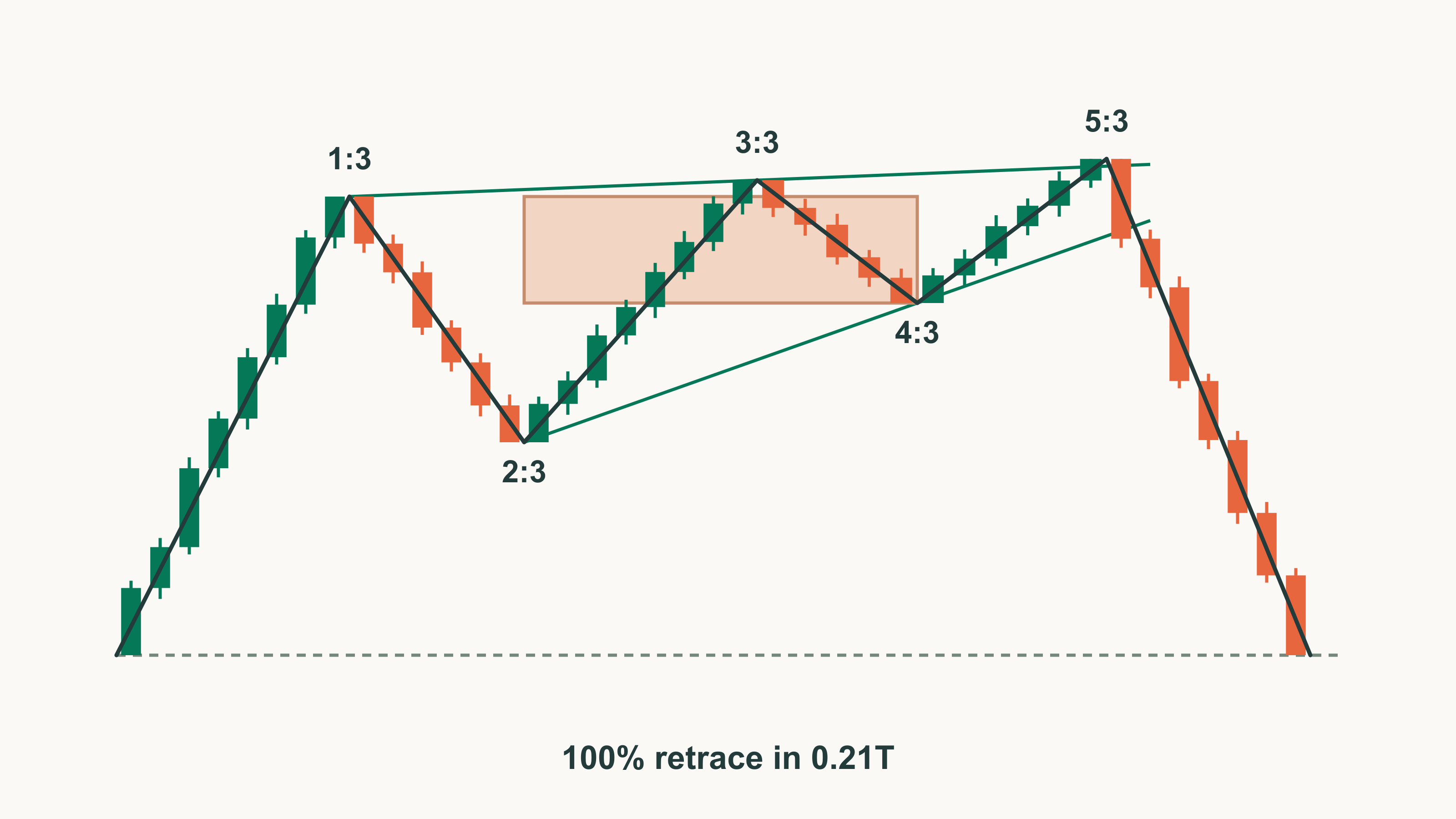
Don't call a terminal from the wedge shape alone. Check that every segment is a 3, where the pattern sits and how fast it's retraced once it ends.
In Part 6 we saw that if wave 4 overlaps wave 2's price range even slightly, the move can't be a trending impulse. Some moves overlap yet still keep the essential impulse rules across all five segments. Elliott called this pattern a Diagonal Triangle; Neely renamed it the Terminal Impulse, both to avoid confusion with horizontal triangles and to better describe what it does.
Most traders know it as a rising or falling wedge. The two trendlines converge or diverge, and in a rising wedge a break of the lower line is read as a reversal signal. A wedge at the start of an advance is sometimes counted as wave 1 of a new trend and called a Leading Diagonal.
By Neely's standard, shape decides nothing. Instead, we check three things:
- Are all five segments corrective?
- Does the pattern sit at the end of a larger one?
- Once it ends, does price return to its starting point within half its formation time?
The third condition can only be checked afterward, and if the retracement doesn't come, it was never a terminal.

A terminal candidate needs all five segments to be 3s
An overlapping wedge isn't automatically a terminal. In structure labels, :5 is an impulse and :3 a correction (Part 4). A trending impulse is 5-3-5-3-5: waves 1, 3 and 5 are five-part impulses and only waves 2 and 4 are corrections. A terminal is 3-3-3-3-3: even waves 1, 3 and 5, which move with the trend, are corrections. In a Q&A Neely explained that waves 1, 3 and 5 are usually zigzags or complex corrections, wave 2 is usually a flat and wave 4 is usually a triangle. Even though all five segments are :3, the whole is an impulse, so when it is compacted into a single wave, its label is :5.
So if any segment inside a wedge turns out to be a five-part impulse, the wedge is no longer a terminal candidate. Take wave 1 of the ETH advance candidate that began on August 29, 2022, from $1,422.08 to $1,606.13. On the 4-hour wave chart it splits into 11 monowaves, and two of its 4-hour bars have a high-low order that even hourly bars couldn't settle. The count alone can't tell you :3 or :5; you have to run Part 4's structure-label procedure on each segment. Our measuring tool doesn't do this automatically, so every example below is treated only as a terminal candidate.
Even if waves 2 and 4 overlap, the impulse rules still apply
Treat the move as a correction the moment wave 4 overlaps wave 2's range, and you'll miss terminal candidates. The book and the Q&As state the overlap condition differently.
- Book: in a terminal, wave 4's range may partly intrude into wave 2's range.
- 2022 Q&A and the official glossary: in a terminal, part of wave 4's range must overlap part of wave 2's range.
Overlap is measured on highs and lows; a close-only line can hide it. Apart from the overlap, the essential impulse rules apply unchanged: wave 2 doesn't fully retrace wave 1, wave 4 doesn't fully retrace wave 3, and wave 3 can't be the shortest of waves 1, 3 and 5. Keeping these rules is what separates a terminal from a horizontal triangle.
Take the BTC daily decline from $25,250 to $19,549 between February 21 and March 10, 2023, as five segments.
| Wave | Price range | Ratio |
|---|---|---|
| Wave 1 | $1,675 | — |
| Wave 2 | $1,025 | retraces 61.2% of wave 1 |
| Wave 3 | $1,878 | 112.1% of wave 1 |
| Wave 4 | $1,278 | retraces 68.1% of wave 3 |
| Wave 5 | $4,451 | 125.3% of waves 1 and 3 combined |
The wave-4 end at $24,000 is $425 above the wave-1 end at $23,575, so it overlaps wave 2's range. It passes the essential rules but fails the trending-impulse condition, which makes it a terminal candidate. Overlap alone doesn't make a terminal; if the five segments fail the essential rules, reconsider the move as a correction.
A terminal appears only at the end of a larger pattern
A terminal always ends a larger pattern, as wave 5 of an impulse or wave c of a correction. According to Neely, terminals with the longest wave 1 mostly appear as wave 5, those with the longest wave 5 usually as wave c, and those with the longest wave 3 are the rarest, probably appearing only as wave c.
The Q&A addresses the wave-1 position separately. Asked whether terminals exist as wave 1 or wave a, that is, leading diagonals, Neely answered "No, they don't exist." That reading arises, he explained, because orthodox Elliott theory sets no requirement for the move after a pattern ends. So counting a wedge at the start of an advance as a NEoWave terminal doesn't fit.
In a real count, record the position too. Just before the February 2023 candidate:
- Prior high: $25,250 on February 16
- Lowest between the two highs: $23,339 on February 17
- Required count: wave c of the correction that began February 16 (a flat candidate with a at $1,911 and b retracing 100% of it)
Calling these five segments a terminal requires this count as well. A wedge whose position you can't explain isn't a terminal candidate.
The location of the longest wave splits terminals into contracting and expanding
Look only for converging wedges and you'll miss the diverging form. When wave 1 is longest, waves 1, 3 and 5 get progressively shorter and the lines converge; when wave 5 is longest, they get progressively longer and the lines diverge. Neely sees the longest-wave-1 form as the most common and the longest-wave-3 form as the rarest. Each form also has ratio conditions.
- Longest wave 1: wave 3 does not greatly exceed 61.8% of wave 1, and wave 5 is shorter than wave 3, most likely 38.2–61.8% of wave 3.
- Wave 5 not the longest: wave 5 must not exceed 61.8% of wave 3.
- Longest wave 5: wave 5 measured from the wave-4 end must be at least the span from the start of wave 1 to the end of wave 3. The same page of the book also says wave 5 is at least waves 1 and 3 combined. In this form, wave 3 doesn't exceed 161.8% of wave 1.
In the Korean edition, the two sentences on the longest-wave-5 form use different standards, so we record both results.
Time here is counted in steps between daily wave-chart points (two per day), with actual time in parentheses.
| Candidate | Wave 1 · wave 3 · wave 5 | Ratio condition |
|---|---|---|
| BTC Feb–Mar 2023 decline (expanding) | $1,675 · 1,878 · 4,451 | wave 5 is longer than the $2,528 span from the wave-1 start to the wave-3 end and is 125.3% of the $3,553 sum of waves 1 and 3, so both sentences pass. Wave 3 is 112.1% of wave 1 |
| BTC Apr 30–Jun 15, 2023 decline (contracting, $29,969→24,800) | $4,158 · 3,096 · 2,592 | wave 3 is 74.5% of wave 1 and wave 5 is 83.7% of wave 3, so it fails the wave-5 condition |
| ETH Aug–Sep 2022 advance (expanding, $1,422.08→1,789.00) | $184.05 · 213.79 · 298.34 | the first sentence passes at $298.34 vs $265.32; for the second, it is 75.0% of the $397.84 sum of waves 1 and 3, short |
The contracting candidate passed the overlap, the essential rules and the post-pattern retracement (13 steps, 6.2 days). Matching shapes alone would skip ratio checks like these.

The standard impulse's time rules do not apply to terminals
Don't rule out terminal candidates with Part 6's time condition. In a trending impulse, wave 2 takes 100% to 300% of wave 1's time, and wave 4 likewise relative to wave 3. Terminals are different.
- 2021 Q&A: wave 2 may end shorter than wave 1, and may exceed 300% but probably not 500%.
- 2022 Q&A: it need not follow the standard impulse's time standard, and extreme alternation can appear between waves 2 and 4.
- BTC Feb–Mar 2023: wave 2's time is 33.3% of wave 1's (1 step vs 3).
- ETH Aug–Sep 2022: wave 2 is 50.0% of wave 1, and wave 4 is 15.4% of wave 3.
- BTC Feb–May 2026 expanding: wave 2's time is 640.0% of wave 1's (32 steps vs 5).
The first two would fail the standard rule outright, but as terminal candidates we don't drop them on these numbers. The third exceeds 500%, which Neely called a level probably not exceeded, not a firm ceiling. So we don't eliminate it on this number alone; we record it as a warning sign.
After it ends, it must be retraced to its start within half its formation time
A break of the wedge's trendline doesn't confirm a terminal by itself. When a terminal ends, the next move must retrace all of it, back to its starting point, in no more than 50% of its formation time. Without that retracement, there was no terminal. The terminal's high or low also must not be exceeded for at least twice the formation time. Neely put the usual retracement time at about 25% of formation time, and in an interview described 25–50% from experience. The 50% ceiling is the book's rule; 25% is a tendency.
| Candidate | Formation | Return to start | Twice the time | Post-pattern condition |
|---|---|---|---|---|
| BTC Feb–Mar 2023 expanding | 35 steps (17.1 days) | March 14, 7 steps (4.1 days), 20.0% | $19,549 holds for 70 steps | pass |
| ETH 2022 expanding | 26 steps (13.7 days) | September 16, 11 steps (5.0 days), 42.3% | $1,789.00 holds for 52 steps | pass |
| BTC Feb–Mar 2026 rising wedge | 41 steps (20.5 days) | low of $67,361 by the March 27 deadline, only 64.0% retraced | $76,000 broken again on April 14 | fail |
| BTC Feb–May 2026 expanding | 179 steps (89.5 days) | June 5, 60 steps (30.2 days), 33.5% | $82,850 broken on September 21 | fail |
- Feb–Mar 2026 rising wedge: from $62,510 on February 24 to $76,000 on March 17, and waves 2 and 4 also overlap. Wave 3 is the longest, so wave 5 can be at most 61.8% of wave 3, but it's 94.2%. It wasn't a terminal.
- Feb–May 2026 expanding: a larger five segments containing the Feb–Mar wedge, from $60,000 on February 6 to $82,850 on May 6. It passes the 50% condition but fails the twice-the-time condition. Wave 5 is longer than the $16,000 span from the wave-1 start to the wave-3 end but only 69.3% of waves 1 and 3 combined, and with the 640.0% noted earlier, it's hard to see as a terminal. Part 8 treats this candidate's wave 5 ($65,000–79,486) as a five-wave impulse and walks through the confirmation procedure on it.
The BTC rising wedge from June 30 to August 15, 2022, a rise from $18,626 to $25,211, also passes the wave-2 and wave-4 overlap and the essential rules. It's the longest-wave-3 form, but wave 5 is 84.0% of wave 3, so it fails the ratio condition first. Its return to start also took 46 steps (23.0 days), 50.5% of the 91-step formation and just over the line. The rule states no tolerance, so we record a fail, noting the miss was half a step.

Below is an example trade plan, separate from Neely's pattern rules. Using the Feb–Mar 2023 BTC candidate in Figure 1, it turns the terminal's post-pattern conditions into an entry, a target and a time stop.
- Entry condition: in five segments that pass the wave-2 and wave-4 overlap, the essential rules and the wave-5 ratio condition (at least 100% of waves 1 and 3 combined) and are a candidate for the end of the correction after the February 16 high, an hourly close above the last rebound high inside wave 5, $20,495. That was the $20,587 close at 1 a.m. UTC on March 11.
- Target: the terminal's starting point at $25,250. It is 22.65% above entry and was reached at 12 p.m. UTC on March 14.
- Stop: below the wave-5 end at $19,549. It is 5.04% from entry, a reward-to-risk ratio of 4.49.
- Time stop: if price hasn't reached $25,250 by the 17th step, half the 35-step formation (the first point of the March 19 daily bar), close what's left of the position.
Failing to reach the starting point by the deadline means the terminal call was wrong. So this plan exits at the time-stop deadline even if the stop price hasn't been hit.
A terminal is confirmed only after two deadlines pass
As soon as you judge wave 5 over, work out the two deadlines.
- Return-to-start deadline: the end point plus 50% of the formation step count
- High/low hold deadline: the end point plus twice the formation step count
As the Feb–Mar 2026 wedge showed, when a pattern looks finished and when it's confirmed are two different times. Part 8 covers the general practice of recording both, and Part 13 explains how wave 5 breaking the 2-4 line can hint at a terminal.
If a terminal fails the post-pattern conditions, recount it as part of a larger five-segment move or as another pattern. Don't rescue a failed count with the missing waves of Part 14, and don't treat a retracement of wave 5 alone as a full retracement. Until the starting point, the 50% deadline and the twice-the-time deadline all check out, record the five segments as a terminal candidate only.