OptiNod Academy
Impulse rules — A long wave 3 does not make an impulse
A Neely impulse has to pass the essential rules, the 161.8% extension, the wave-4 overlap rule, alternation and the wave-2 and wave-4 time rule. We test each one on four BTC stretches.
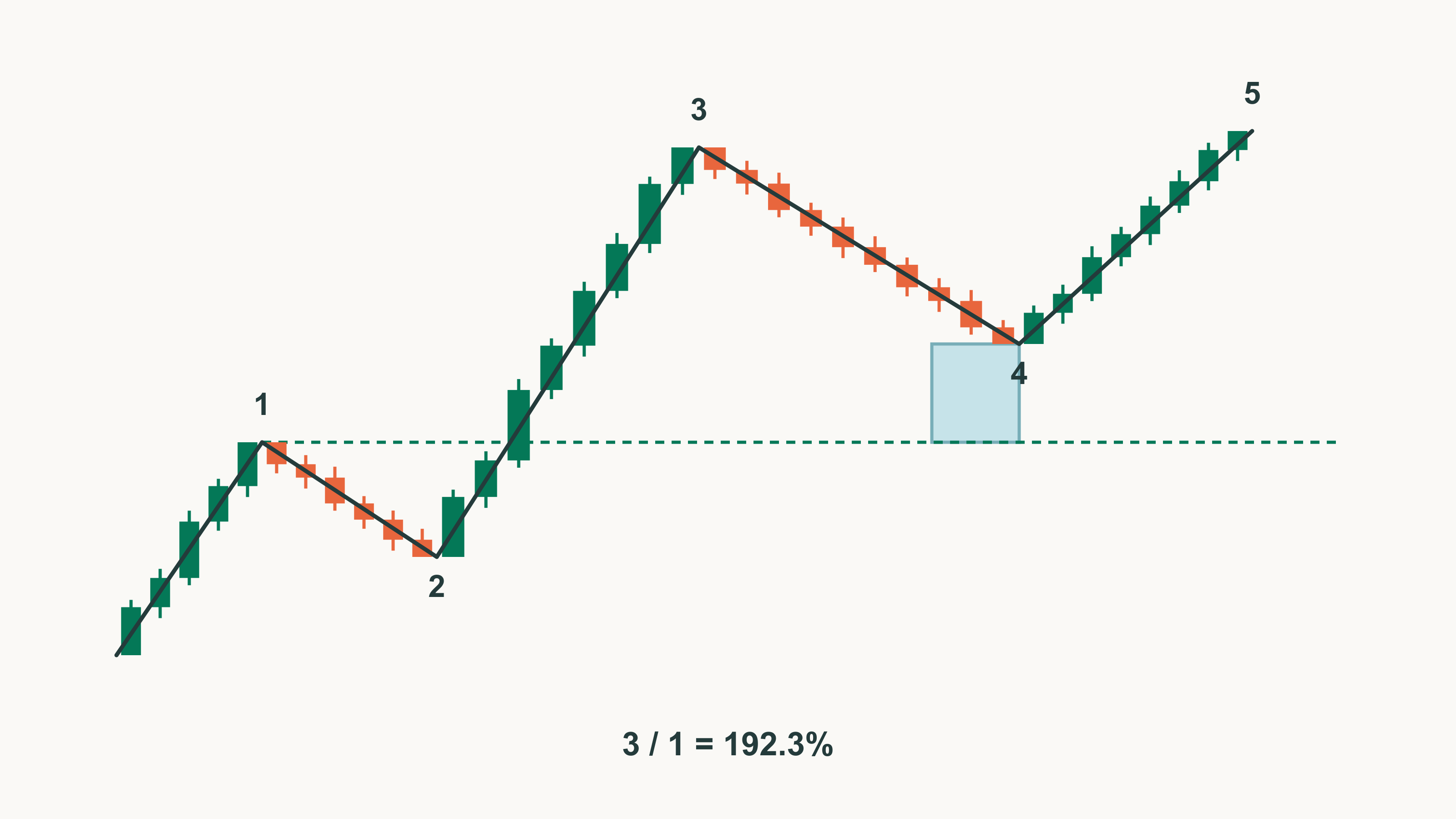
A long wave 3 doesn't make a move an impulse. Check the extended wave, alternation and the wave-4 overlap first.
In Part 5, we judged whether waves share a degree from the price and time relationship of neighbors, without switching timeframes. Now we ask whether five waves grouped that way form an impulse. If a move breaks even one essential construction rule, Glenn Neely doesn't treat it as an impulse; he treats it as a correction or as waves grouped wrongly.
Two shortcuts are common. One says a move is an impulse if wave 3 is the longest and strongest. The other says coins have long wicks, so a brief dip of wave 4 below the wave-1 high is fine as long as the closes hold. Neither matches Neely's rules. Wave 3 only has to avoid being the shortest, but one of waves 1, 3 and 5 must be noticeably longer than the others. And the wave-4 overlap is judged on the actual price range.
Count a correction as an impulse, and you'll expect a large retracement after wave 5 while you keep trading a trend that is really a correction. Here we apply the rules one at a time to four BTC stretches and see where each one passes and fails.
The five legs of each stretch are marked at highs and lows on fixed dates. We didn't check whether each leg is :5 (impulse) or :3 (correction); structure labels are explained in Part 4. Time is counted in steps, the intervals between points plotted on the wave chart. The daily wave chart has two points per bar, so one day is two steps.
Breaking even one essential rule removes a move from impulse candidates
No rule says wave 3 must be the longest. Among waves 1, 3 and 5, the only condition on wave 3 is that it can't be the shortest. The essential construction rules of an impulse are:
- Five: exactly five connected monowaves or larger waves, with waves 1, 3 and 5 in the same direction.
- Wave 2: does not completely retrace wave 1.
- Wave 3: longer than wave 2, and must not be the shortest of waves 1, 3 and 5.
- Wave 4: does not completely retrace wave 3.
- Wave 5: at least 38.2% of wave 4. If it is shorter than wave 4, it is called a failed (failure) wave 5.
Figure 1 shows a BTC decline candidate from April 14 to June 22, 2021, starting at $64,854. We'll run it through each rule in this article.
| Wave | End price | Price range | Daily wave chart time |
|---|---|---|---|
| Wave 1 | $46,930 | $17,924 | 23 steps |
| Wave 2 | $59,500 | $12,570 | 29 steps |
| Wave 3 | $30,000 | $29,500 | 19 steps |
| Wave 4 | $41,330 (stretch high $42,452) | $11,330 | 53 steps |
| Wave 5 | $28,805 | $12,525 | 14 steps |
It passes all five. Wave 2 retraced 70.1% of wave 1, wave 4 at its deepest retraced 42.2% of wave 3, and wave 5 is 110.5% of wave 4. Only candidates that pass the essential rules move on to the next check, the extension rule; passing here doesn't yet confirm an impulse.

Without an extended wave, a long wave 3 still does not make an impulse
For Neely, extension is a feature found only in impulses. One of waves 1, 3 and 5 must be noticeably longer than the other two, with 161.8% as the standard. The book and the Q&As differ on what it's compared with.
- Book (1990): the longest wave must be at least 161.8% of the second-longest wave.
- 2006 Q&A: it is enough for the longest wave to be at least 161.8% of the shortest wave. Exceeding 161.8% of the second-longest is the more typical picture.
- 2010 Q&A: only reconfirms that a 1-2-3-4-5 without an extended wave is not an impulse, and does not mention the denominator.
No revision says it replaces the book, so we calculate both standards.
- April–June 2021 decline candidate: the longest wave 3 at $29,500 is 164.6% of the second-longest wave 1 at $17,924, and 235.5% of the shortest wave 5. It passes both standards, but by the book standard it is close to 161.8%.
- 2023–2024 advance candidate: from $24,800 on June 15, 2023 to $73,777 on March 14, 2024. The longest wave 5 at $35,222 is 146.3% of the second, wave 3, so it fails the book standard, while it is 502.9% of the shortest wave 1, so it passes the 2006 standard.
For the second candidate, the verdict depends on which wave you divide by. If two people read the same chart differently, check which denominator each one used.
In a trending impulse, check wave 4's overlap on the actual price range
Don't excuse a wave-4 wick below the wave-1 high by looking at the close. In a trending impulse, no part of wave 4 enters wave 2's price range, meaning wave 4 never shares a price zone with waves 1 and 2. The rule holds only on cash data. For an advance candidate, wave 4's low must stay above the high at the end of wave 1. Nothing in the book or the Q&As tells you to judge by the close.
The BTC advance candidate starting at $28,850 on January 22, 2021 shows the difference.
| Standard | Wave 1 | Wave 4 | Result |
|---|---|---|---|
| Actual price | end high $34,875 (Jan 25) | low $32,172 (Jan 31) | $2,703 overlap, fails as trending |
| Daily close | highest close in stretch $32,945 | lowest close in stretch $33,093 | $148 apart, looks like no overlap |
In this candidate wave 5 rose to $58,353 on February 21, 281.8% of wave 3, so it passes the extension rule. The overlap alone still rules it out as a trending impulse.

If wave 4 touched wave 2's range, don't erase the wick to keep the count trending. Look again, considering a terminal impulse, a correction or a wrong wave split. A terminal is a pattern in which the price ranges of waves 2 and 4 overlap, explained in Part 7.
Alternation is satisfied if it appears in just one of five items
If you read alternation only as "sharp wave 2, sideways wave 4," you'll miss alternation that shows up elsewhere. The Rule of Alternation says neighboring waves of the same degree must differ; in an impulse, it compares waves 2 and 4. There are five things to compare, and the waves must differ in at least one.
- Price: the price range each wave covered
- Time: the time each wave took
- Depth: the ratio by which each retraced the prior wave. Used only for waves 2 and 4 of an impulse.
- Complexity: the number of internal subwaves
- Construction: different pattern types, such as a flat on one side and a zigzag on the other
The Figure 1 candidate shows no alternation in price, but it does differ elsewhere.
| Item | Wave 2 | Wave 4 | Difference |
|---|---|---|---|
| Price | $12,570 | $12,452 (wave-3 end to stretch high) | wave 4 is 99.1% of wave 2, none |
| Time | 29 steps | 53 steps | wave 4 is 1.8 times |
| Depth | 70.1% of wave 1 | 42.2% of wave 3 | yes |
| Complexity | 23 monowaves | 37 monowaves | yes (reference value) |
Complexity is the raw monowave count on the daily wave chart. We didn't apply the Rule of Neutrality, so treat it only as a reference. On short timeframes it's hard to find differences other than depth, and depth alone makes alternation hard to be sure of. Check all five items and record how many differ.
Waves 2 and 4 take as long as or longer than the waves before them
A candidate that passes every price rule can still fail on time. In a trending impulse, wave 2 takes 100% to 300% of wave 1's time, and wave 4 takes 100% to 300% of wave 3's. This condition comes from a 2021 Q&A, and both 100% and 300% count as allowed. A 1996 Futures magazine article likewise says that, apart from rare terminals, waves 2 and 4 take at least 100% of the time of waves 1 and 3. Terminals are exempt: their waves 2 and 4 can be shorter than the waves before them.
With this condition, more candidates fail.
| Candidate | Wave chart | Wave 2 ÷ wave 1 | Wave 4 ÷ wave 3 | Judgment |
|---|---|---|---|---|
| April–June 2021 decline | daily | 126% | 279% | passes, wave 4 close to 300% |
| 2023–2024 advance | daily | 211% | 10% (25 steps ÷ 243 steps) | fails |
| January 2021 advance (overlap example) | 4-hour | 56% | 117% | fails |
Counted in daily bars, the first candidate has wave 3 at 9 days and wave 4 at 27 days, exactly 300%. That's still allowed, so it passes right at the boundary. If you've only checked the price rules, work out the time ratios before you trust the count.
The shape and the equality rule change with which wave is extended
Any of waves 1, 3 and 5 can extend, and which one does sets the overall shape of the impulse. Figure 3 shows, from top to bottom, BTC candidates whose longest wave is wave 1, wave 3 and wave 5.

- Wave-1 extension: wave 2 cannot retrace more than 38.2% of wave 1, and wave 5 must be the shortest of the three. The top candidate in Figure 3 has wave 2 retracing 42.3% of wave 1, and wave 1 is 118.0% of wave 3, short even of the book's extension standard. Wave-1 extensions have an exception: if wave 3 does not go beyond the end of wave 1 by more than 61.8% of wave 1, it may fall slightly short of 161.8% (here 61.8% means 61.8% of wave 1's price length; the book's wording alone doesn't settle the base, so we use this commonly cited reading). This candidate's wave 3 goes only 42.4% of wave 1 beyond the end of wave 1, so it meets this condition, but 118.0% is hardly "slightly short" of 161.8%. The wave 2 and wave 4 times counted on the weekly wave chart are also 82% and 74%, failing the 2021 Q&A's time condition.
- Wave-3 extension: Neely holds that if an extension appears, it is most likely in wave 3. The middle candidate is this case.
- Wave-5 extension: wave 4 must be more complex and take longer than wave 2, and the ratio by which it retraces wave 3 must also be larger than the ratio by which wave 2 retraced wave 1. The bottom candidate in Figure 3 has wave 4 at 25 steps, shorter than wave 2's 120, and a depth of 43.3%, smaller than wave 2's 98.6%, so it does not fit this shape.
The two non-extended waves tend to be equal in price or time, or related by a Fibonacci ratio such as 61.8%. This is the Rule of Equality. Price matters more than time here, and the rule fits wave-3 extensions best. In the middle candidate, waves 1 and 5 have a price ratio of 69.9%, close to neither 100% nor 61.8%. In time, wave 5's 14 steps are 60.9% of wave 1's 23 steps, close to 61.8%. Because price matters more, we note that this candidate shows equality only weakly, in time. Unlike the essential construction rules, the Rule of Equality doesn't eliminate candidates, so this value doesn't rule the count out.
Before turning an impulse candidate into a trade plan, write down the rule-breaking price and time first
Below is an example trade plan, separate from Neely's pattern rules. It's written as if wave 4 of Figure 1's decline candidate were still in progress, and it builds the rules' invalidation price and time into the plan.
- Extension check: at the time of wave 4, wave 3's $29,500 is 164.6% of wave 1's $17,924. If wave 5 grows longer than $18,232, the book-standard extension ratio drops below 161.8% even if wave 5 ends shorter than wave 3, so keep re-measuring wave 5's length to the end.
- Price invalidation: if any high during the wave-4 rebound touches the wave-1 end at $46,930 even once, drop the trending impulse count. Judge by hourly highs, not closes.
- Time invalidation: wave 3 was 19 steps on the daily wave chart, so wave 4 must end within 57 steps, 300%, that is, by the first point of the June 17, 2021 daily bar. The actual wave 4 ended at $41,330 on June 15 after 53 steps, 4 steps before the deadline.
- Entry and stop: if you judge wave 4 over and sell along the wave-5 decline, put the stop above the wave-4 high of $42,452. This stop is a trading level and is managed separately from the count's invalidation price of $46,930.
This plan sets no target for wave 5. The end of the impulse is confirmed by a break of the 2-4 line and a full retracement of wave 5. Part 8 explains that process, and Part 13 covers the 2-4 line. Of the four candidates, only the April–June 2021 decline passed extension, overlap and time, and even there the book-standard extension ratio (164.6%) and wave 4's time (279% of wave 3) were both close to the boundary. There's also an alternative count that treats the stretch after the same wave-3 end as a seven-leg correction (Part 15), in which case the June 22 low isn't the end of an impulse. When you set up an impulse count, write down the extension ratio and its denominator, wave 4's actual low and high, and the wave-2 and wave-4 time ratios. If even one doesn't fit, look at a correction or terminal before an impulse.