OptiNod Academy
Diametric and symmetrical — judge seven- and nine-leg ranges by time symmetry
After the book, Neely set out conditions for diametrics, symmetricals and neutral triangles in his official Q&A. We test them against the leg sizes and times of four BTC sections.
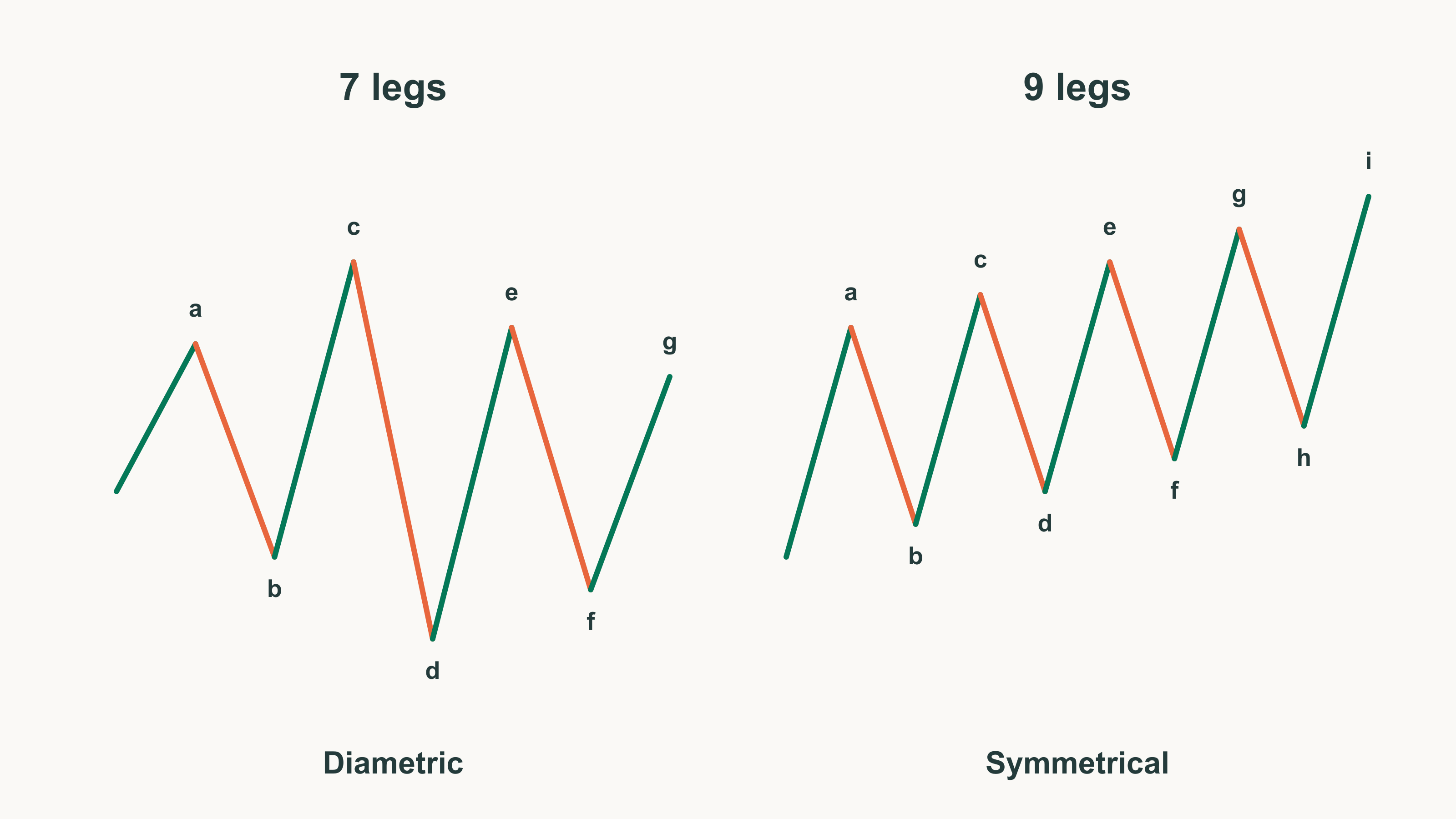
Don't force a seven- or nine-leg range into an ABC or a triangle; judge it by the symmetry of leg size and time.
In Part 14, we concluded that you need evidence before adding a missing wave to a count that's short on monowaves. This part takes the opposite case: a range with more than five legs that doesn't meet the X-wave conditions either.
Such a range is usually handled one of two ways: seven swings get split into two ABCs and an X wave, or read as a triangle with two extra legs tacked on. After his book (1990), Glenn Neely described separate patterns for these sections: the seven-leg diametric, the nine-leg symmetrical, and the neutral triangle, whose middle leg is the longest. None of the three is in Mastering Elliott Wave, and their rules come from Neely's official Q&A published on neowave.com.
Where you cut the legs depends on which pattern you're looking at. Count the five legs after BTC's $73,777 high on March 14, 2024 one by one, and each takes a similar 10–14 steps of high/low point spacing. Part 9 grouped b–d of the same section into one wave B and counted it as a flat candidate. Only the structure inside the legs, measured together with the time ratios, can settle which reading is right.
Here we compare the leg sizes and times of four BTC sections with Neely's numeric standards. Leg ends are the highs and lows of a wave chart built with a percent filter; we didn't check the structure inside the legs.
Narrow the pattern candidates by the time differences of the first three legs
Neely said he first noticed the diametric in the early 1990s, the symmetrical around 2001, and the neutral triangle from the mid-1990s on. He also said the book's rules still stand; the new patterns are an extra option for sections that don't fit its 3- and 5-leg patterns.
Start with the time differences among the first three legs.
- Large time differences: flat or zigzag
- Times somewhat similar: triangle
- Times very similar, prices different: diametric
- Both time and price very similar: symmetrical
The legs are lettered straight through, a–g or a–i, with no X wave. If B takes less time than A, drop the zigzag and flat candidates. An earlier answer adds a condition to the same test: B must be at least 61.8% of A.
Here we count each leg's time in high/low point spacing on one chart. A daily chart has two points per day, so these counts differ from calendar days.
A diametric is seven legs with similar times and different prices
It's tempting to think that the better the Fibonacci ratios fit, the more correct the count. A diametric is the opposite: its legs have no Fibonacci relationships in price or time.
- Shape: the width grows over the first four legs (a–d) and shrinks over the last three, or the reverse. Neely called the first form, expanding then contracting, a bow tie, and the second, contracting then expanding, a diamond. Because the names are easy to mix up with the shapes, we describe them by expanding/contracting order instead.
- Time (2009 Q&A): the time ratio of adjacent legs is above 61.8% and below 161.8%, usually with one leg as an exception. Use it when the whole is 55 monowaves or fewer; beyond that, move to a time frame five times larger.
- Time (2022 Q&A): the time difference between adjacent legs is 0–15%.
- Price: adjacent legs usually retrace more than 61.8% of the previous leg. b-d and d-f overlap isn't required.
- Structure: the whole condenses to structure label :3 (correction, Part 4). It can't occupy waves 1, 3 or 5 of a trending impulse or wave c of a flat or zigzag.
We found no statement that the 2022 standard replaces the 2009 one. So for each case we record verdicts under both time standards side by side and flag any failure.
We split BTC daily from March 14 to April 19, 2024 into seven legs. Leg a runs from $73,777 to $60,775 ($13,002), and the whole has 51 monowaves.
| Leg | Size relative to a | Time (point spacing) |
|---|---|---|
| a | 100% | 12 steps |
| b | 84.6% | 14 steps |
| c | 56.0% | 14 steps |
| d | 63.9% | 11 steps |
| e | 93.4% | 10 steps |
| f | 47.7% | 3 steps |
| g | 55.9% | 8 steps |

Legs a–e are similar in time. The problem is f.
- 2009 standard: f is 30.0% of e, outside the range, but passes if f is taken as the one exception.
- 2022 standard: only two of the six adjacent pairs fall within 15%, so it fails.
- Retracement: f retraces e by 51.1%, short of 61.8%.
- Shape: the first four legs mostly shrink, and in the last three f and g are smaller than e too, so the pattern never turns to expansion.
Record this section as a diametric candidate, but first recheck the structure at f's position.
Confirm the diametric is over by the move after g
The move that follows confirms whether g has ended, and what that move looks like depends on the larger pattern the diametric completed.
- Step 1: the wave after g must be larger and faster than any same-direction leg inside g.
- Step 2: if that wave is also larger and faster than b, d and f, the diametric completed one leg of a larger pattern. Otherwise, an X wave may be forming.
- Limits on g: price no more than about 161.8% of e, and time no more than the combined time of d, e and f.
In the 2024 candidate, the advance after g ran $7,632, from $59,600 on April 19 to $67,232 on April 22. That's smaller than b ($10,995) and d ($8,305) and slower than f, so it doesn't meet the confirmation condition.
BTC from May 19 to June 29, 2021 is another seven-leg candidate. It has 57 daily monowaves, so we found the legs on the weekly wave chart (9 monowaves). Leg a runs from $30,000 to $40,841 ($10,841).
| Leg | Size relative to a | Time (weekly point spacing) |
|---|---|---|
| a | 100% | 1 step |
| b | 68.8% | 1 step |
| c | 56.2% | 2 steps |
| d | 78.2% | 1 step |
| e | 95.3% | 2 steps |
| f | 115.5% | 3 steps |
| g | 71.9% | 1 step |
- Shape: it shrinks through c and grows through f, but d is already larger and g shrinks again, so it only partly matches the contracting-then-expanding shape.
- 2009 standard: c/b, d/c, e/d and g/f fall outside the range, so it fails a standard that allows only one exception. Under the 2022 standard too, only one pair falls within 15%.
- g: price is 75.5% of e, and time 1 step, within the 6-step sum of d, e and f. But it retraces f by 62.2%, nearly equal to 61.8%.
The decline after g fell $7,322 to $29,278 on July 20 over 20.7 actual days, smaller and slower than b, d and f. Going by the move after g alone, that decline is an X-wave candidate, but the pattern still failed the time condition. A $23,642 advance to $52,920 on September 7 followed.
Part 6 and Part 13 counted the same section as waves 4 and 5 of a declining impulse. One count ends wave 5 at $28,805 on June 22 and the other ends f there, so the move that follows has to test both. Before you call g finished, tabulate the size and speed of b, d and f, and compare the move after g against that table.
In a symmetrical, same-direction legs are nearly equal in price and time
Nine swings don't automatically make a symmetrical. A symmetrical has nine legs, a–i, with no X wave, and it's the only pattern in which nearly every leg is equal in time, price and complexity.
- Same-direction legs: price and time differences of 0–10%.
- Adjacent opposite-direction legs: no set rule.
- Middle leg e: must not be the shortest in price.
- Limits on i: price no more than about 161.8% of g, and time no more than the sum of f, g and h.
In Neely's view, symmetricals that clearly slant up or down are the more common kind.

We counted BTC from $73,777 on March 14, 2024 to $52,550 on September 6 as nine legs.
- Declining legs a, c, e, g, i: price ranges of $12,450–$21,080, with the largest leg 169.3% of the smallest, and times of 12–57 steps.
- Advancing legs b, d, f, h: prices spread up to 138.0%.
Both groups blow well past the 10% standard, so this isn't a symmetrical. Read the first seven legs as a diametric instead, and two adjacent pairs, at time ratios of 325.0% and 31.9%, fall outside the range and fail the 2009 standard. No pair meets the 2022 standard either. If you've put nine labels on a long range, first work out the size differences among the five and the four same-direction legs.
A neutral triangle is five legs with C the longest
If you only sort triangles into contracting (A longest) and expanding (E longest), you'll miss neutral triangles. The type depends only on which of A, C and E is longest in price; if it's C, the triangle is neutral.
- A and E: at least 38.2% of C, usually 61.8–72%, and A and E tend to be similar in size.
- Limit on C: usually about 161.8% of A, with up to 261.8% allowed in very volatile markets. Even then, B and D must overlap.
- Thrust: about 75% of the width of the largest leg. The largest leg is usually C but can be B or D. If it's a limiting triangle in a wave-B or wave-4 position, the thrust time is about 20–40% of the formation time.
Thrust standards for contracting triangles and the 2007 revision are in Part 11.
We take BTC daily from August 8 to October 10, 2024 as a neutral candidate.
| Leg | End | Size |
|---|---|---|
| A | August 15, $56,079 | $6,667 |
| B | August 25, $65,000 | $8,921 |
| C | September 6, $52,550 | $12,450 |
| D | September 27, $66,498 | $13,948 |
| E | October 10, $58,946 | $7,552 |
- A and E size: A/C is 53.6% and E/C 60.7%, passing the minimum condition but slightly smaller than the usual range.
- C size: C/A is 186.7%, allowed only in very volatile markets.
- B and D: they overlap at $56,079–$65,000, and the largest leg is D.

Here's how the thrust after E played out.
- 75% point: reached $69,407, the end of E plus 75% of D, on October 21.
- Up to 40% of formation time: up to the last observation point at 9 PM November 4 (UTC), the high was $73,620, 105.2% of D.
- Whole thrust: to $104,088 on December 5, 323.6% of D, over 111 steps of point spacing, 88.1% of the 126-step formation time.
The thrust ran well past 20–40% of the formation time, so discard the count that puts this candidate as a limiting triangle in a wave-B or wave-4 position. Check other positions instead, such as the final slot of a larger correction.
Write the end-confirmation standards and invalidation numbers into the trade plan
Below is an example trade plan, separate from Neely's pattern rules. If you took the March–April 2024 seven-leg candidate as a diametric, you'd write down these numbers in advance.
- Candidate conditions: seven legs, adjacent leg time ratios above 61.8% and below 161.8% (one leg excepted), every retracement of the previous leg above 61.8%, and 55 or fewer monowaves on the wave chart.
- Waiting to enter: price must pass $70,595 from the end of g (exceeding b's $10,995), and since it must be faster than the fastest leg f ($2,068.8 per step of point spacing), wait until it gets there within 5 steps.
- Stop-loss: below the end of g at $59,600.
- Invalidation: if g exceeds 161.8% of e and falls below $47,229, or lasts longer than the 24 steps of d, e and f combined, discard the diametric count.
- Neutral triangle candidate: set the first zone from the end of E up to 75% of the largest leg. In the August–October 2024 candidate, that was $69,407. If the move keeps going strongly in the same direction after 40% of the formation time has passed, drop the limiting-triangle assumption.
Seven- and nine-leg verdicts get sharper with the structure inside the legs and the chart unit
- Structure inside the legs: public material only confirms that the whole diametric condenses to :3; we couldn't confirm structure conditions for individual legs. f in the March–April 2024 candidate was a single monowave, and in the 2021 candidate six of the seven legs on the weekly chart were single monowaves, so they can't be confirmed by internal structure. If a leg is a single monowave, it may be part of a smaller degree, so reread the structure label with the method in Part 4.
- Chart unit: the 2009 standard's 55-monowave condition sets a chart size on which leg times show clearly. The 2024 nine-leg candidate has 257 daily monowaves (39 weekly), so it should be recounted on the weekly chart.
Middle legs, such as d of a diametric or e of a symmetrical, are the hardest to judge structurally. When a range has more than five legs, try the 2020 X-wave conditions in Part 12 first. Only if they don't fit should you measure time symmetry and log the range as a diametric or symmetrical candidate.