OptiNod Academy
Triangles — where the triangle sits decides the size of the breakout
Neely's triangles split into contracting and expanding, with three variations, and in a wave-B or wave-4 position the thrust's upper limit is about 161.8%. We measure size and time on six BTC, ETH and SOL sections.
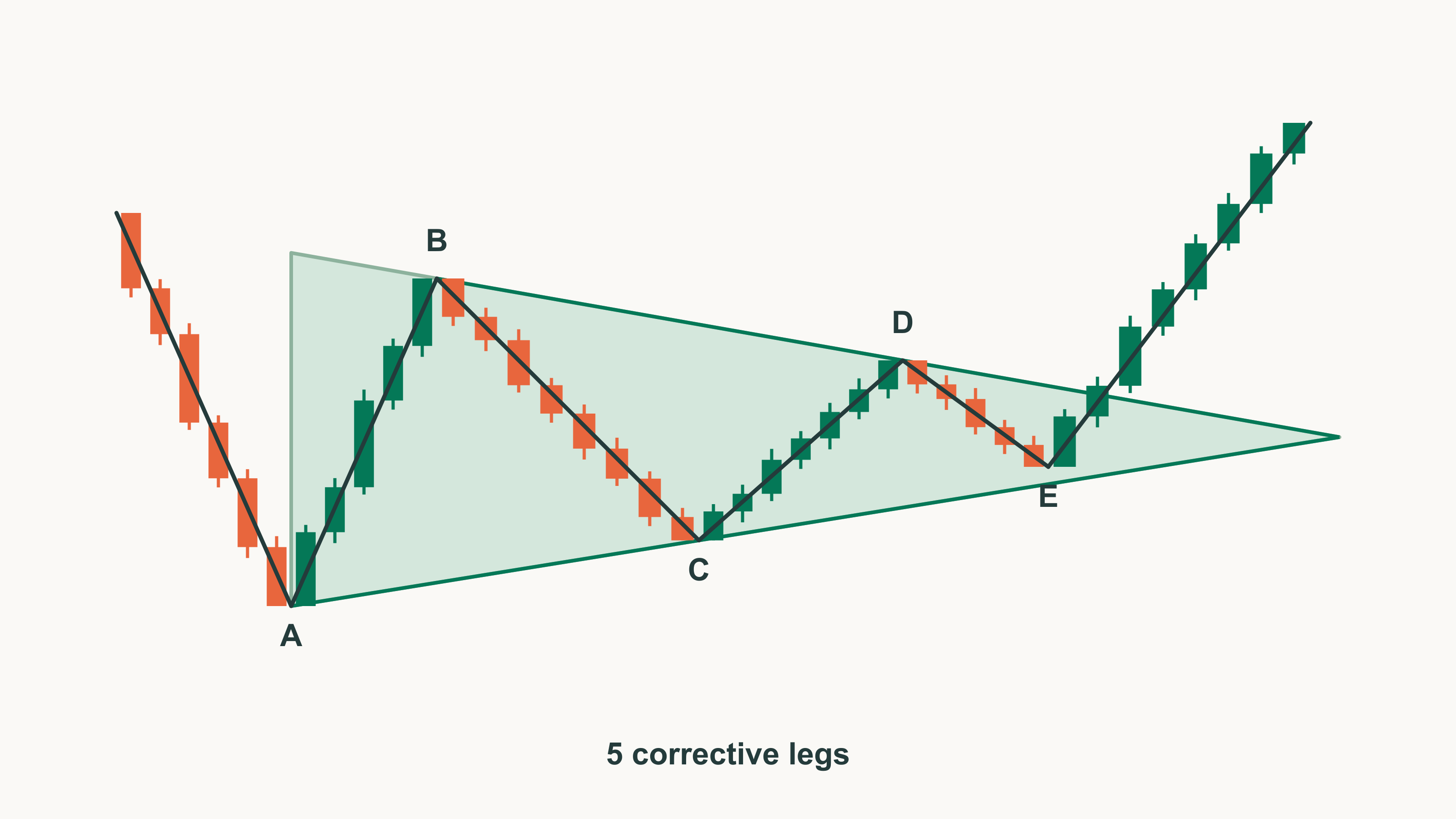
Don't use one multiple as a triangle's breakout target; first check where the triangle sits and whether it's limiting or non-limiting.
In Part 10, we sorted zigzag variations by wave C's length and wave B's depth. Now we turn to the triangle, a five-leg correction. Glenn Neely calls it the hardest pattern in wave theory, but once it's fully formed, he says, it offers plenty of clues about the move that follows.
The usual approach treats any wedge with falling highs and rising lows as a triangle and, on a breakout, projects a move as wide as the triangle's widest part. Neely's standard is different. Some triangles expand rather than contract, and contracting triangles come in three variations. The size of the breakout move (the thrust) also depends on the variation and the position. In 2007, Neely corrected the relevant part of the book, lowering the thrust's upper limit for a triangle in a wave-B or wave-4 position to about 161.8% of the longest leg.
Here we classify six BTC, ETH and SOL sections by the order of their leg sizes and measure the size and time of the thrust. We found the candidate sections with a percentage filter and took the leg ends from the highs and lows of a daily or 4-hour wave chart. Each thrust runs from the end of E until the same filter registers an opposite move.
A triangle is a correction where five :3 legs move back and forth over a similar price zone
Don't jump to calling a five-swing sideways move a triangle. The structure label :3 means a correction and :5 an impulse (Part 4), and despite its five legs, a triangle is a :3. The minimum conditions are:
- Number of legs: exactly five, in order A, B, C, D, E. Each leg is a completed correction, or :3 if it's a monowave.
- B/A: wave B's price range is at least 38.2% and at most 261.8% of wave A. B equal in length to A is rare.
- Retracement: at least three of B, C, D and E retrace 50% or more of the prior leg's price range.
- Trendlines: of the six points, the four at the ends of A, B, C and D usually touch two trendlines, while the start and the end of E don't. The B-D line plays the same role as an impulse's 2-4 line.
In a contracting triangle, wave E must be the smallest leg by price. Here's how the June 26 to July 5, 2022 section on BTC's 4-hour chart measures up as a contracting candidate.
- A: $21,888 → $18,626, $3,262
- B/A: 70.3%
- Retracement of the prior leg: B 70.3%, C 93.2%, D 79.4%, E 69.2%, all four legs at 50% or more.
- E: 36.0% of A, the smallest of the five legs.
Passing all this still only makes it a candidate.
Contracting and expanding split by which of A, C and E is longest
Look only for narrowing shapes and you'll miss expanding triangles. In an official Q&A, Neely said a triangle's type depends solely on which of legs A, C and E is longest in price, not on B versus D or the shape of the channel. If A is longest it's contracting, if E is longest it's expanding, and if C is longest it's a neutral triangle. The neutral triangle isn't in the book, so it's covered in Part 15.
In an expanding triangle, A or B is the smallest leg, and E is almost always the longest. E usually also takes the most time and has the most complex structure. The thrust must be smaller than E, the widest leg, unless the expanding triangle is the last leg of a larger correction. Expanding triangles don't appear as wave B of a zigzag or as wave B, C or D of a larger triangle.
Take the April 13 to June 7, 2024 section on BTC's daily chart as an expanding candidate.
- A: $60,661 → $66,867, $6,207
- E: $56,553 → $71,997, $15,444, 248.8% of A. With 51 monowaves, it's also the longest in time and the most complex in structure.
- Retracement of the prior leg: B 117.1%, C 105.0%, D 139.9%, E 144.6%; all four legs passed the prior extreme.

The decline from $71,997 on June 7 to $53,486 on July 5 is $18,511, 119.9% of E. For this to be an expanding triangle, it would have to be the last leg of a larger correction; otherwise, revisit the end of E or the count. Don't apply a contracting triangle's breakout target to an expanding candidate, and if the thrust exceeds E's length, question the position assumption first.
Horizontal, irregular and running split by wave B and trendline direction
Running triangles aren't limited to the upside. The Korean translation of the book calls them "bullish triangles," but this series uses "running." A contracting triangle in a wave-B or wave-4 position splits into three variations.
- Horizontal: the two trendlines point in opposite directions, D is smaller than C and E smaller than D. The apex where the two lines meet lies within 61.8% of the longest leg, measured from that leg's middle.
- Irregular: B is longer than A. B is at most 261.8% of A and usually under 161.8%. C, D and E are each smaller than the leg before, and the two trendlines point in opposite directions.
- Running: B is longer than A and the longest of the five legs. C is smaller than B, D larger than C, and E smaller than D. Both trendlines rise, or both fall.
Chapter 10 of the book gives a different breakout size for each variation: about the size of the longest leg, give or take 25%, for horizontal; around 161.8% for irregular; up to 261.8% for running. The 2007 revision covered in the next section changed the running triangle's 261.8%.
Here are two candidates' leg sizes measured against A.
| Candidate | B | C | D | Trendlines | Variation |
|---|---|---|---|---|---|
| ETH daily, May 12 to June 6, 2022 | 126.4% | 85.4% | 76.1% | A-C line falling, B-D line rising | Irregular |
| SOL daily, August 14 to September 1, 2025 | 110.9% | 82.7% | 95.6% | Both rising | Running |
In the ETH candidate, B is $464, A is $367 and E is 49.9% of A. In both sections A is the longest of A, C and E, so by the official Q&A's classification they're contracting triangles too. The variation is named only after measuring B and D and the slopes of the two lines.
After the 2007 revision, the thrust limit in a B or 4 position is about 161.8%
Don't assume every triangle is a wave 4 or wave B. By position, triangles fall into two groups.
- Limiting triangle: appears in a wave-4 or wave-B position and limits the size of the move that follows.
- Non-limiting triangle: appears at the end of a complex correction, as an X wave, as the E of a larger triangle, or as wave 5 of a terminal impulse. There's no set limit on the breakout size.
In a 2007 official Q&A, Neely said the book's explanation of the running triangle's 261.8% thrust needed correcting. A 261.8% thrust appears only after a non-limiting triangle ("can ONLY occur after a non-Limiting Triangle"), and the thrust from a wave-B or wave-4 triangle maxes out near 161.8% of the longest leg. Neely said to treat this as a firm rule. So in a B or 4 position, running or irregular, the upper limit is about 161.8%.
The ETH candidate broke through this limit. In a limiting triangle, the time from the end of E to the apex is 20–40% of the formation time; 40% or more is a sign of non-limiting.
- End of E: $1,920 on June 6
- Thrust: fell $844.20 to $1,075.80 on June 14, 181.9% of B, the longest leg.
- End of E → apex: 55.4% of the formation time (point spacing), 51.8% in actual time.
If you'd counted this sideways move as a wave-B triangle, you'd have to reclassify it as non-limiting or redo the count. The apex time points the same way.

A thrust that's too small also means E wasn't the end. A contracting triangle's thrust must be at least 75% of the longest leg and must clear the triangle's high or low in the breakout direction, unless the triangle leans strongly against that direction. The January 24 to March 9, 2022 candidate on BTC's daily chart has A as the longest leg at $12,904, with the legs shrinking in order.
- Thrust: from $42,594 on March 9 to $37,555 on March 14, 39.1% of A, and it didn't reach the triangle's low of $32,917.
- The move after: it rose to $48,190 on March 28, passing the triangle's high of $45,821.
So discard the count that ends E on March 9.
The thrust takes about 20–40% of the triangle's formation time
A breakout of the right size doesn't prove the triangle count either. A later official Q&A added a time standard. The thrust stage of wave C or wave 5 after a limiting triangle in a wave-B or wave-4 position takes about 20–40% of the time the triangle took. It applies to contracting, expanding and neutral triangles alike. The apex standard measures from the end of E to where the trendlines meet; the thrust-time standard measures the thrust itself.
Time is counted in wave-chart steps. Each bar has two points, so one bar is two steps, and the apex is located on the same chart. We also remeasured in actual time from 1-hour bars, and every verdict held. The time ratios in the table are relative to the formation time.
| Candidate | Thrust size | Thrust time | End of E → apex |
|---|---|---|---|
| BTC 4-hour, June–July 2022 | 98.8% of A | 28.7% | 92.4% |
| BTC 4-hour, March–April 2023 | 92.6% of A | 35.5% | 27.4% |
| ETH daily, May–June 2022 | 181.9% of B | 30.0% | 55.4% |
| SOL daily, August–September 2025 | 156.5% of B | 91.9% | 269.6% |
The BTC June–July 2022 candidate formed over 9.0 days, and the thrust rose from $19,304 on July 5 to $22,527 on July 8. The two trendlines point in opposite directions and the apex is within 61.8% of A measured from its middle, so it's a horizontal candidate, and as the table shows, its thrust size (98.8%) and time (28.7%) fit the horizontal range too. But the end of E to the apex is 92.4%, a sign of a non-limiting triangle, so you can't conclude it's a limiting wave-B or wave-4 triangle.
The BTC 2023 candidate passed the thrust size, thrust time and apex time standards. Taking $26,508 on March 27 to $29,969 on April 30 as a contracting triangle candidate, B/A is 90.3% and E is the smallest at 60.9% of A. The two trendlines point in opposite directions and the apex is within 61.8% of A measured from its middle. The formation time is 408 steps of point spacing. The thrust fell to $25,811 on May 12, also passing the triangle's low of $26,508.

The SOL running candidate is the reverse of the ETH one: its size is within the limit, but it fails on time. The thrust was $59.32, from $194.19 on September 1 to $253.51 on September 18. The time is 34 steps of point spacing against a formation time of 37 steps, and the actual-time ratio is 89.6%. For this candidate to stay a wave-4 triangle, the thrust should have ended by the 7 PM UTC point on September 8 at the latest. When a thrust overruns the time range, revisit the position assumption.
Write the position assumption and both limits into the trade plan
161.8% isn't a breakout target. It's an upper limit that must not be passed under the B or 4 assumption.
Below is an example trade plan, separate from Neely's pattern rules. Its numbers are fixed in advance so you can switch scenarios immediately if the B or 4 assumption proves wrong.
- Candidate conditions: five legs, B/A of 38.2–261.8%, and at least three legs retracing 50% or more of the prior leg. If contracting, A is the longest of A, C and E, and E the smallest.
- Position assumption: write down the grounds for seeing it as wave B or wave 4 in the larger wave. Also measure whether the end of E to the apex is 20–40% of the formation time. The BTC April 2023 candidate is 27.4%. If there are no grounds or it falls outside this range, keep the non-limiting possibility open and don't use the size limit in the plan.
- Target: if horizontal, the first target zone is 75–125% of the longest leg from the end of E. The BTC April 2023 candidate broke down, so that's $26,600–$24,355, and the actual thrust ended at $25,811.
- Size check: if it passes 161.8% of the longest leg, drop the B or 4 assumption. In the same example, that's $22,702.
- Time check: if the thrust keeps going in the same direction past 40% of the formation time, switch to a non-limiting or complex-correction scenario. In the same example, that's the point 163 steps later, 4 AM UTC on May 14.
Triangle verdicts get accurate through leg structure and checks after E
- Leg structure: check that all five legs are :3. The legs here are extremes found by a filter, and we didn't measure their internal structure. The ETH candidate's A was 3 monowaves, and the expanding candidate's A was 1. If any leg turns out to be :5, the section is no longer a triangle candidate, whatever its extremes.
- The move after E: once the B-D line is broken, treat the triangle as finished. In a contracting triangle the thrust must pass the triangle's high or low; if it doesn't, as with the BTC March 2022 candidate, reset the position of E. The confirmation deadlines and stages were covered in Part 8.
Once you've counted five legs, write down whether the triangle sits in a wave-B or wave-4 position, and check it against the size and time limits that go with that assumption.